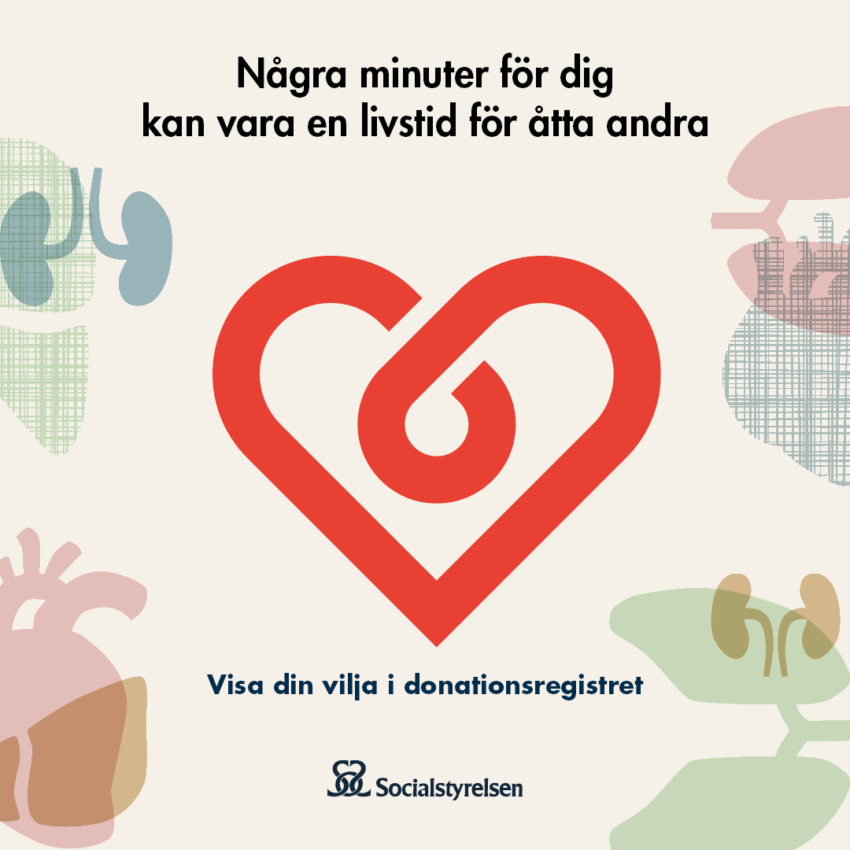
Right now, Sweden’s national Donation Week campaign is underway — an initiative designed to encourage more people to make a decision about organ and tissue donation.
Whether you’re for or against donating your organs or tissues after death, make sure to register your choice in the National Donation Register.
It’s free, takes less than a minute, and you can change your decision anytime.
A few clicks can save and transform many lives
One organ donor can save up to eight lives, and donated tissue can help fifty people.
Donations to medical research projects aimed at improving treatment for diseases like diabetes and cardiovascular disease can change the lives of countless others around the world.
Visit https://donation.socialstyrelsen.se/donation/
Log in. Make your choices. Done!
Be sure to share your wishes with your loved ones — and bonus points if you encourage them to make their own choices known in the register.
Your body – Your decision
In Sweden, everyone has the right to decide for themselves whether they want to donate their organs and tissues after death. That decision must always be respected.
You can read more about the legal framework in Section 3 of the Transplantation Act 1995:831
Children under 15 can be registered by a guardian. From the age of 15, the person can update or remove their registration themselves.
After a death, the hospital staff begin an inquiry to determine whether consent for donation exists. They check the Donation Register and consult the next of kin.
If relatives can’t be reached, or if there’s uncertainty, conflicting information, or the person’s wishes are unknown, no donation takes place. That’s why it’s so important to register your decision — to help both medical staff and your loved ones.
More information from the National Board of Health and Welfare (Socialstyrelsen):
About donation:
https://www.socialstyrelsen.se/donationsregistret/om-donation/
Questions and answers:
https://www.socialstyrelsen.se/donationsregistret/fragor-och-svar/
Whole body donation
You can also choose to donate your entire body for medical and anatomical education.
Whole body donation is not the same as organ or tissue donation and is not handled by the Donation Register — instead, you make an agreement directly with one of Sweden’s medical universities.
Read more about whole body donation here:
https://www.socialstyrelsen.se/donationsregistret/om-donation/
(under the heading Donation för forskning och utbildning:
Helkroppsdonation för medicinsk undervisning)
There you’ll also find contact information for institutions that accept whole body donations.
Donations you can make while still alive
Become a blood donor:
https://geblod.nu/other-languages/english/
Donate stem cells:
https://tobiasregistret.se/en/
Donate a kidney:
https://www.socialstyrelsen.se/ansok-och-anmal/anmal/om-donationsregistret/
I want to encourage organ and tissue donation — but the choice is always yours.!
No one should ever feel pressured or forced, in either direction.
You can do so much good for others simply by being present and giving a moment of your day. Something as small as a friendly smile, a “Hello!”, “Thank you!” or “You’re welcome!” can brighten a stranger’s day.
Have you registered your choice in the Donation Register yet? If not — what’s stopping you?
A short story with Quinley & Herrow

Who are Quinley and Herrow?
In Coffinfolk Café’s stand alone short stories, you’ll meet two most unlikely friends:
Quinley – Coffinfolk’s café host. A young woman who loves life just as much as she loves exploring the cultural heritage of death and sharing advice, information, and insights that can help people – whether they are facing their own encounter with Death or living with grief.
Herrow – Death himself. He may look frightening in his black cloak, but beneath the bones is a kind soul who enjoys a cup of coffee and sharing experiences gathered from every corner of time.
You can find a longer introduction + a short story about their first meeting HERE
“A Bittersweet Gift”
Narrated by Quinley
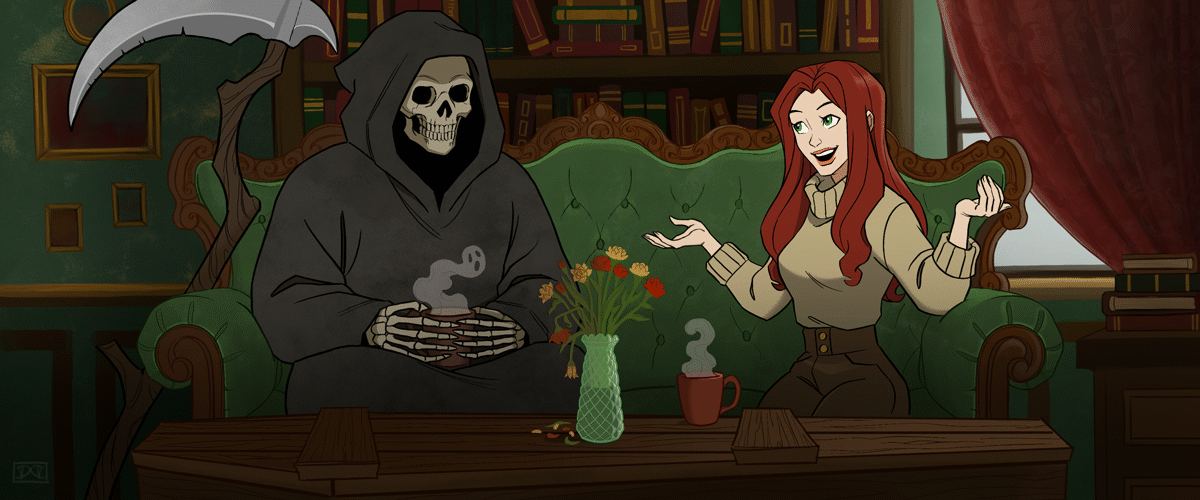
I dropped down on the sofa opposite Herrow with a wide grin on my face.
“I’ve done it!”
The Reaper looked up from his newspaper and tilted his head with a soft clicking sound.
“Congratulations! What is it you’ve done...?”
“Signed up as an organ donor! I’ve been meaning to do it for ages but never got around to it.” I turned toward the counter, where Harley sat with an open binder in front of him. “Have you signed up?”
“Yep! When I die, they can reuse the spare parts for both donation and research. The rest goes back to Mother Earth.”
I took a sip from my coffee cup.
“Herrow, do you have any opinions about organ donation? Does it make any difference to you?”
“I collect your soul, not your body. It makes no difference to my work.”
With nimble fingers, he folded the newspaper and set it down on the coffin we used as a coffee table.
“It made a difference for me,” a guest at a nearby table chimed in. “My husband needed a new heart to survive. The morning we got the phone call that they’d found a match...” she pushed her glasses back up her nose “We’ll never know who the donor was, but we think of him — and his loved ones — every year on that date. July 17th.”
I swallowed hard. A decision that had felt so simple and obvious now carried a completely new weight.
“Thank you for sharing that.” The woman smiled at me.
“Thank you for choosing to donate. I’m just grateful that people are willing to give away something as symbolic and emotionally charged as their heart. I don’t blame anyone who chooses not to.”
“Same here. It has to be a voluntary choice. My body, my decision.”
Herrow’s raspy chuckle broke the heavy silence.
“This is exactly what the world needs more of.”
“Organ donations?” I asked.
“That too,” the Reaper said, sweeping one bony hand between us living. “But I was thinking more of what we’re seeing right here — compassion and understanding.”