

Charon is the ferryman of Greek mythology, the one who carried the souls of the dead to the underworld, Hades.
Was he pleasant company on the journey? And what happened if you couldn’t pay for the crossing?
Here you can read a little more about the figure who ferried souls between worlds — and unlike the ferryman’s own transport service, this one is completely free.
Image: ’Charon Crossing the Styx’ painted by Joachim Patinir 1520-1524
The Old Workhorse at the Helm
Charon is often described as an old man with unkempt, tangled hair and a bushy beard. His clothes are worn and hang like rags from his emaciated body.
The monotonous, often thankless nature of his work has made him tired and surly — and under Roman influence, sometimes even outright frightening.
Who were his parents? How did he come to work as a ferryman? What kind of relationship did he have with the other gods?
No one knows, and perhaps that was exactly how Charon wanted it. “Mind your business, and I’ll mind mine.”
The Ferryman: the Grim Reaper as a Seafarer?
Not quite — but almost.
Both figures are psychopomps (Greek for “guides of souls”), meaning beings whose task is to escort the deceased to the afterlife. They do not judge and have no say in what happens to a person’s soul beyond death. Whoever you were in life, you are met in the same way by these creatures.
The difference is that the Grim Reaper comes to a person at the moment of death and retrieves (or “reaps”) their soul, while the ferryman waits at the water’s edge for the soul of the deceased to step aboard.
The Grim Reaper comes to you — you must come to the ferryman.
The Grim Reaper performs his task for free, while the ferryman expects payment.
You can read more about the history of the Grim Reaper HERE.
A One-Way Ticket to the Underworld
One of the most well-known details about Charon is that he had to be paid for the journey to Hades.
At the funeral, a silver coin — called an obol, or Charon’s obol — was placed in the mouth of the deceased. The dead were given this coin so they could pay the ferryman and cross into the underworld.
Later, it became common to place two coins over the eyes, a tradition that lived on in Europe and other parts of the world. By then, the coins were no longer only meant to pay the ferryman, but also to keep the eyes of the deceased closed. Even today, small weights are used for the same purpose, although other methods are becoming increasingly common in the Western world.
So what happened if you couldn't pay?
The soul was forced to wander along the shore for one hundred years. These souls were homeless, restless, and unable to find peace. They cried out, lamented, and felt a deep longing to be allowed into Hades.
That is why it was so important that the deceased received a proper burial — and their coin for Charon.
Being stranded between worlds was not something one wished upon a beloved family member.
I believe we have all encountered someone like Charon in real life.
The old workhorse who performs his duty year after year. The worker everyone depends on, yet easily forgets — until the day he is no longer on duty and everything descends into chaos.
Next time we meet a “Charon,” perhaps we should try to cheer the old man up a little?
Now that you’ve gotten to know Charon a bit better, would you like to explore your own personification of Death? Read more HERE.
A short story with Quinley & Herrow

Who are Quinley and Herrow?
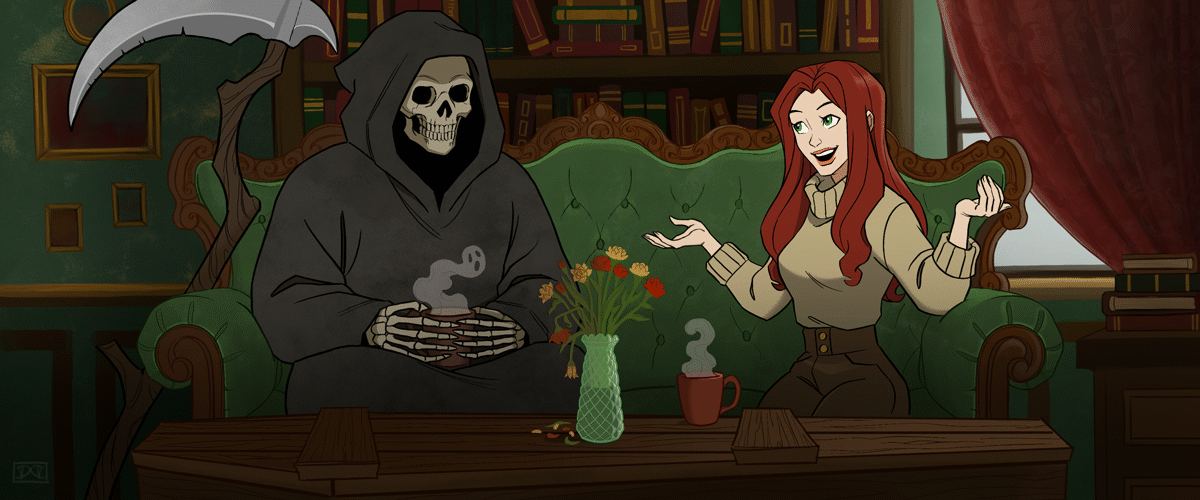
In Coffinfolk Café’s stand alone short stories, you’ll meet two most unlikely friends:
Quinley – Coffinfolk’s café host. A young woman who loves life just as much as she loves exploring the cultural heritage of death and sharing advice, information, and insights that can help people – whether they are facing their own encounter with Death or living with grief.
Herrow – Death himself. He may look frightening in his black cloak, but beneath the bones is a kind soul who enjoys a cup of coffee and sharing experiences gathered from every corner of time.
You can find a longer introduction + a short story about their first meeting HERE
“The Forgotten Ferryman”
Narrated by Quinley
🎶 Don’t pay the ferryman
Don’t even fix a price 🎶
Chris de Burgh’s 80s hit playing in my headphones felt perfectly fitting as I sat there with the ferry’s engine rumbling beneath me, on my way back to the mainland — or “the realm of the living,” as my friend liked to call it.
Sabina never understood how I could be envious of having to travel by boat to get into the city, especially not in winter, which already came with more than enough trials without adding seafaring to the mix.
When I and a handful of other passengers stepped aboard, the captain welcomed us in a tone that sounded as though the words had long since lost their meaning to him.
He must have gone through every step hundreds, perhaps thousands of times. I wouldn’t have been surprised if he could run this route in his sleep.
My fellow passengers seemed to feel the same — the journey had clearly lost its charm as they scrolled through their phones, flipped through a newspaper, or took the opportunity to nap.
I sank deeper into my seat and gazed out at the white landscape where daylight slowly gave way to winter darkness.
A familiar scent of lilac, juniper needles, and old books tickled my nose. When I glanced toward the previously empty seat across from me, I realized I was no longer alone. I paused the music and slipped off my headphones.
Herrow raised a bony finger to his lips. With his other hand, he gently let two fingers close my eyelids.
“Take the opportunity to rest a little, Quinley.” Herrow’s soft, raspy voice sounded almost like part of the wind whispering outside the window. It took only a minute or two before the gentle rocking of the waves lulled me to sleep.
Somewhere far away, I heard my name. Someone lightly shook my shoulder.
I forced one eye open. Familiar empty eye sockets stared back at me from a skull.
“Time to wake up. We’ll be in port soon.”
“Thank you,” I whispered back, stretching.
“Ha! That’s not a word I hear very often in my line of work,” Herrow chuckled, leaning back in his seat as I pulled on my hat and fastened my coat.
“You should hear it more often.” When I reached into my pocket to fish out my gloves, my fingers instead found a bundle of business cards. That gave me an idea.
The captain’s tired voice announced the ferry’s next stop.
I let the other passengers disembark before me. Not one of them spared so much as a glance at the old man standing hunched by the railing, making sure everyone made it ashore safely.
“Thank you. You should know that you’re appreciated.” I handed him a Coffinfolk business card along with a voucher for a free cup of coffee.
“Well then… much obliged,” he said, extending a hand marked by a lifetime of work in wind and weather.
As he turned his back and trudged back toward the wheelhouse, he shook his head, muttering something inaudible, before slipping the card into the pocket of his worn coat.
After a few steps on solid ground, I turned around and waved.
The captain waved back, and I could swear I saw a small smile beneath his bushy beard — back at his post at the helm, where with practiced hands he ferried people to and from “the realm of the living.”
Herrow slipped an arm around my shoulders as we continued toward the sleepy city.
I put my headphones back on and pressed ‘play’.
🎶 Don’t pay the ferryman
Until he gets you to the other side 🎶
My family all the time say that I am wasting my time here at web, except I know I am
getting knowledge all the time by reading
such good posts.