
Today, we are often expected to function as usual, even when life has just fallen apart.
In the past, it was normal—almost expected—to wear one’s grief on the outside as well.
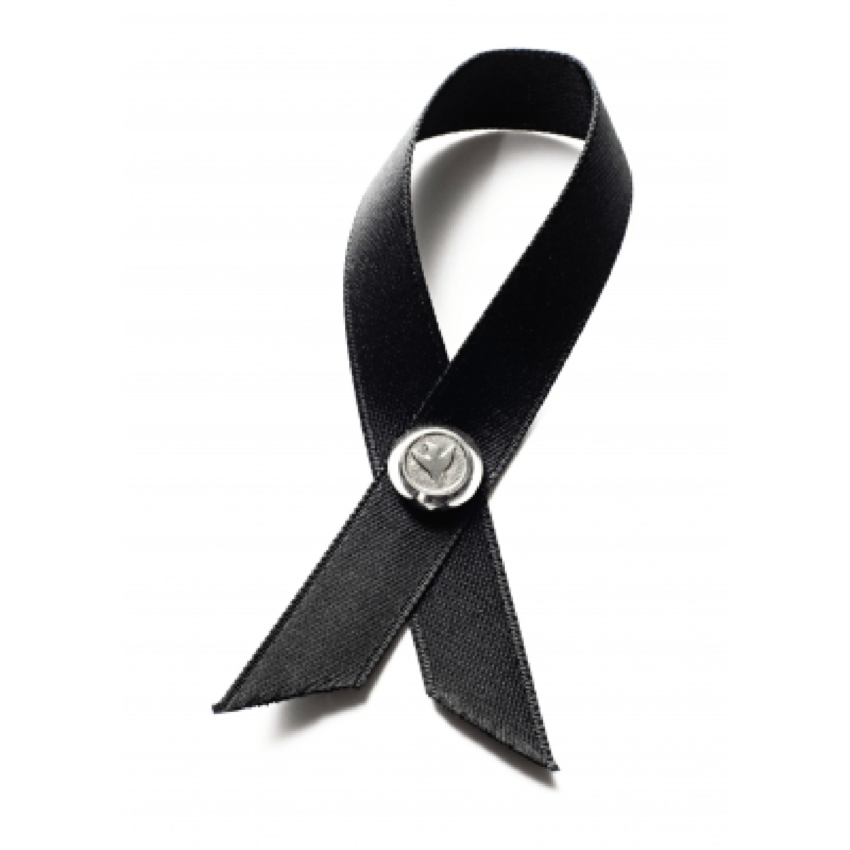
Perhaps you have seen such a marker at some point: a thin black band on a lapel, or a black armband on an athlete’s arm.
An increasingly rare symbol that shows someone is carrying grief and longing.
Images: Courtesy by Sveriges Begravningsbyråers Förbund
The History of the Black Band
In earlier times, it was taken for granted to wear a black armband around the left arm on one’s coat or jacket after a death in the family. This symbol of mourning was worn from a few weeks before the funeral until three to six months after the death. Sometimes, the mourning band was worn for as long as a year.
In the 1960s, the thin mourning band worn on the lapel was introduced.
In the 1970s came the mourning button—a button often covered in black fabric, also worn on the lapel.
In the 1980s, the use of both mourning bands and mourning buttons began to fade, and today it is relatively uncommon to see someone wearing a symbol to show that they are grieving.
The black armband lives on in sports, where athletes may wear it to show that they themselves, their team, or the sport as a whole has lost someone.
Why the Color Black?
Black has long been the color associated—here in Sweden and across much of Europe, North America, and Australia—with death, loss, grief, and longing.
The color often symbolizes formality, endings, “nothingness,” and, of course, the process of mourning.
If you are interested in how we use colors in our encounter with death, you can read more about how the world assigns color to what often cannot be described with words in the blog post “The Colors of Grief”, which you can find HERE.
Would You Like to Wear a Symbol of Your Grief?
The classic thin mourning band can be purchased through funeral homes and via Sveriges Begravningsbyråers Förbund:s online shop, which you can find HERE.
Black armbands for athletes are available at most sporting goods stores.
Etiquette for the Mourning Band: Who? How? Where? When?
Anyone who is grieving has the right to wear a mourning band.
Today, it is most common to wear the band at the funeral, but it is entirely up to you to decide how long you wear it.
The grieving process is rarely simple or free from setbacks, so it is always acceptable to remove and put the mourning band back on depending on how your grief feels on a particular day or in a particular moment.
You can also adjust how noticeable the mourning band is through the color of your clothing. Dark clothes make the band more subdued, while light clothes make it more eye-catching.
When You Meet Someone Wearing a Mourning Band
Show a little extra care. Give the person more time and space.
When someone is grieving, it is not always easy to think or act quickly. One often feels out of sync with the rest of the world, so a bit of extra consideration from others can make a great difference.
At the same time, it is important not to overdo it to the point where the grieving person feels “contagious,” as if people avert their eyes and flee as soon as they come close.
Asking how the person is doing or how things related to the grief are going can be a sensitive subject. In those cases, it may be easier for both parties if you, as an outsider, say:
“I’m happy to listen if you want to talk.” That way, the grieving person can choose how much they want to share without feeling pressured to respond or worried that their heavy emotions will bring down your mood.
I hope it can become more common again to openly show that one is grieving.
These feelings are too big for people to have to “hide away” in public.
Grieving is not ugly, nor is it a sign of weakness—it is human. 🖤
Do you think mourning bands, or other symbols of grief, should become more common again?
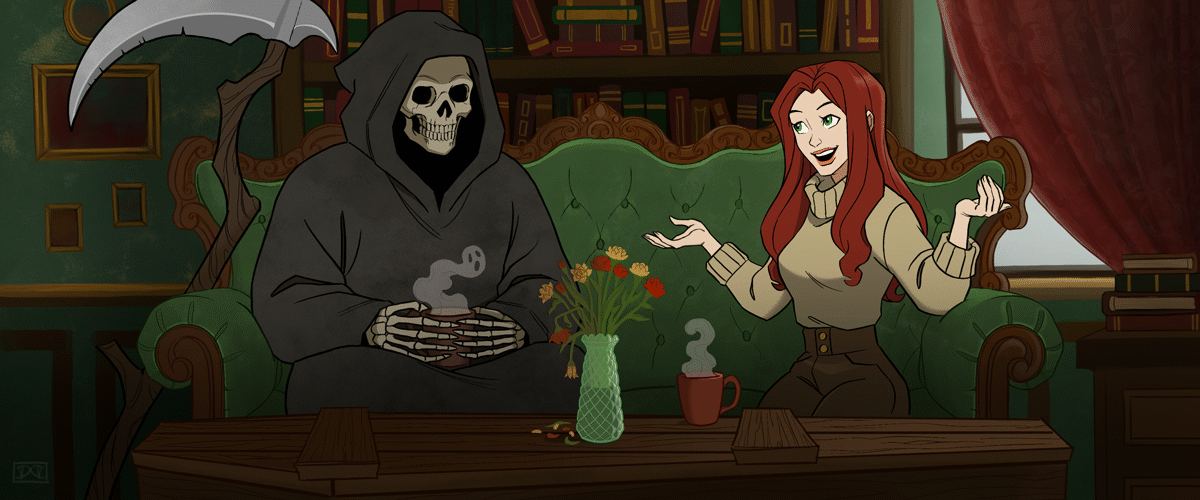
A short story with Quinley & Herrow

Who are Quinley and Herrow?
In Coffinfolk Café’s stand alone short stories, you’ll meet two most unlikely friends:
Quinley – Coffinfolk’s café host. A young woman who loves life just as much as she loves exploring the cultural heritage of death and sharing advice, information, and insights that can help people – whether they are facing their own encounter with Death or living with grief.
Herrow – Death himself. He may look frightening in his black cloak, but beneath the bones is a kind soul who enjoys a cup of coffee and sharing experiences gathered from every corner of time.
You can find a longer introduction + a short story about their first meeting HERE
“Dare to be sad”
Narrated by Quinley
It wasn’t something I saw often at the café, but it always moved me just the same.
To think how much such a small ribbon can say. Or a small button, for that matter.
One quiet afternoon, I was sitting with Herrow, talking about the symbolism of different flowers in death and funerals. In other words, a perfectly ordinary coffee break at Coffinfolk.
The little bell above the door chimed as a guest stepped inside, seeking shelter from the winter cold. When she pulled off her hat, I recognized the steel-gray curls threaded with purple highlights.
“Hi, Emelie—come on in. Take a seat. The usual?”
Emelie nodded briefly and settled into the sofa beside Herrow while I prepared a cup of black coffee with exactly one and a half teaspoons of sugar.
“Thank you, dear,” she said, accepting the cup with a small smile.
When I sat down across from her, I noticed the black mourning band pinned to her sweater. Emelie followed my gaze, tore the band loose, and tossed it onto the table. She glared at it as if it had personally offended her.
“Do you want to talk about it?” I asked gently, taking a sip of my own coffee.
Emelie turned toward Herrow, as if searching for support—or rescue.
The reaper extended a bony hand and laid it over hers.
“All feelings are welcome here. You may speak freely, my friend.” His soft, raspy voice made Emelie’s shoulders relax just a little. With a sigh, she turned back to me.
“It… it felt right to wear it at the funeral,” she said, gesturing toward the black ribbon on the table. “Almost everyone did. Somehow, it made you feel less alone—without having to say anything.”
“But…?” I prompted softly.
“Now it feels— it feels like I’m branded. Like people see it and think, ‘Oh no, she’s grieving! Run!’ As if grief were some kind of dangerous infection. As if I should stay away until I’m happy again…” Emelie sniffed and wiped away a tear before it could fall.
I reached across the coffin we used as a coffee table and took her free hand in mine.
“You haven’t done anything wrong. Showing your grief openly takes both courage and strength.”
“Then I guess I’m just a weak coward…” Emelie muttered with a snort, before another sob made her shudder.
“Don’t twist my words, missy,” I scolded gently, smiling. “Other people not knowing how to behave isn’t your fault. Grief is hard to navigate, no matter which side of it you’re on.”
“I don’t know what it feels like to grieve the way you mortals do,” Herrow added with a dry chuckle, “but I can relate to what it’s like when people are afraid of you—or become uncomfortable the moment you’re mentioned.”
“How do you deal with it?” Emelie asked, turning her hand and intertwining her fingers with Herrow’s.
“I am who I am. I can’t change that to please others.” The reaper shrugged, his bones making a soft clicking sound. “I hope it becomes easier for people when it’s once again accepted and normal to see me, to talk about me. Or even to share a cup of coffee together.” Herrow lightly clinked his cup against Emelie’s.
I picked up the small black ribbon from the table.
“After my grandmother passed away, I always wore my mourning band. It felt good that it could often say what I didn’t always have the strength to: ‘I’m fragile right now.’ It was like a shield. A small shield made of silk ribbon.”
“I wish I could feel that way—” Emelie fell silent as the little bell above the door announced another arrival.
Another familiar face at the café. Katarina smiled when I welcomed her in from the cold. The black ribbon had returned to her lapel—it had been a few weeks since I last saw her wearing it.
Emelie noticed it too. The two women exchanged a brief nod, but it was more than a greeting; it was an acknowledgment: "I know what grief feels like."
Katarina took a seat farther inside the café, and as I prepared her cup of chai tea, I heard Herrow whisper to Emelie:
“It can be more than just a shield. It can also be a lighthouse, when you feel as though you’re drifting alone on the open sea.”
Emelie gave Herrow a long look.
“You’re a wise one. Will you help me put my lighthouse back in place?”
Herrow chuckled softly and, with nimble fingers, fastened the black mourning band where it belonged once more.
Emelie joined me as I served Katarina, who happily accepted the company at her table.
Back on the sofa, I gave Herrow a broad smile.
“What if it could always be like this? Imagine what a piece of silk ribbon and a cup of coffee can do.”
Herrow nodded and put down his cup.
“One meeting at a time,” he replied. “Sometimes you need a shield to hide behind; sometimes you need a lighthouse to show that you’re not alone. What matters is that there’s room for both.”