
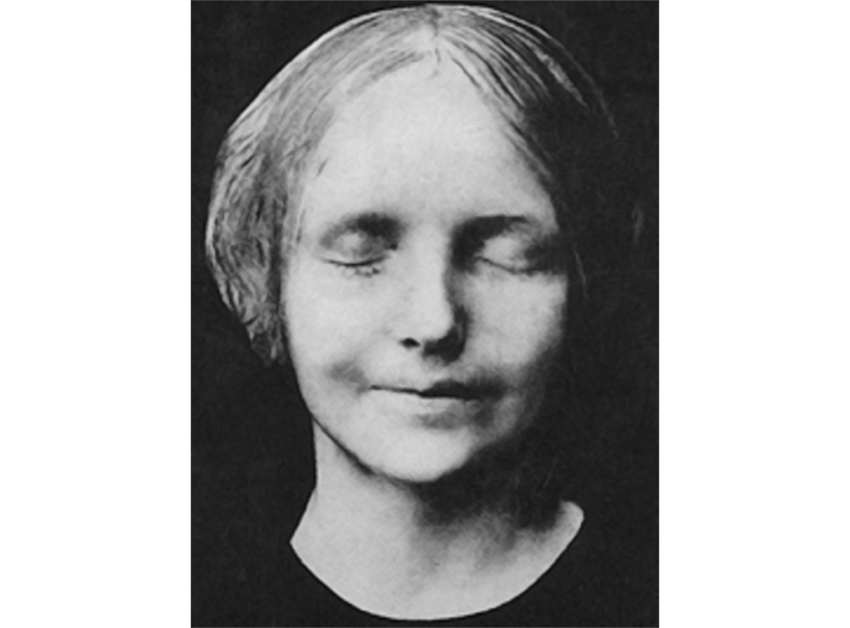
Paris, late 1880s. A young woman is found dead in the river Seine. Not unusual in itself—the river had claimed many lives, through accidents, crime, and suicide. Sadly, it still does today.
What made this anonymous woman so remarkable was her face. So peaceful it almost looked as if she were simply asleep.
In this post, you’ll learn about the Unknown Woman of the Seine, who went from an unidentified drowning victim to an artistic icon and one of the most kissed faces in the world.
Death as a trend and entertainment
This was a time when death wasn’t only a natural part of life; it also had a significant influence on art and literature. Dying or dead beautiful women, in particular, carried a strong poetic—and sometimes erotic—charge.
The drowned woman was such a common motif in writing and painting that she could almost be considered a stereotype.
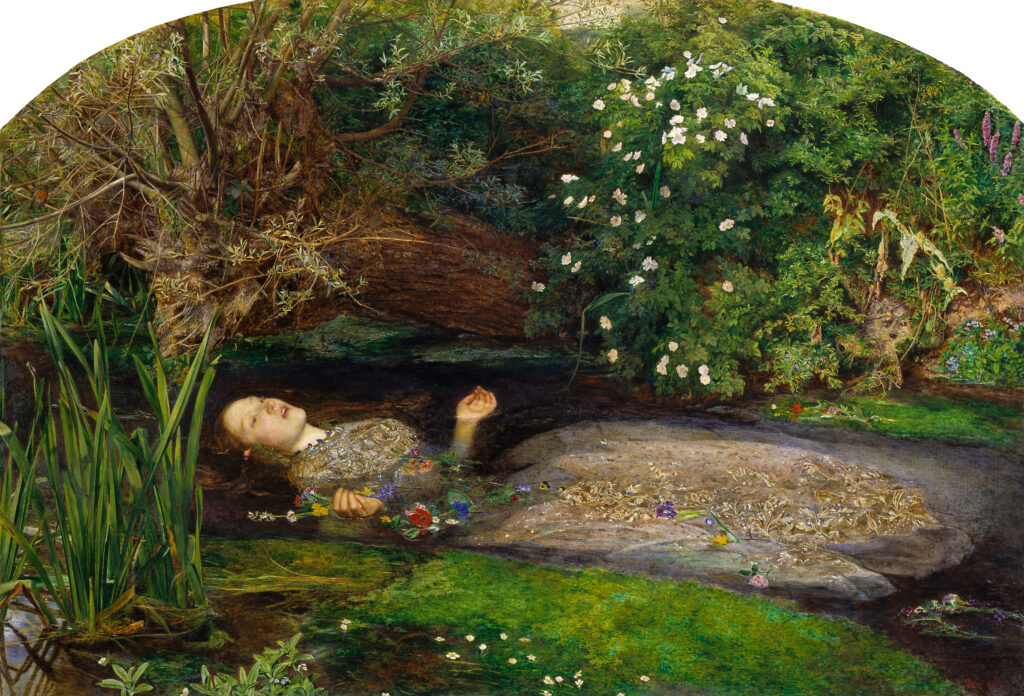
Ophelia from Shakespeare’s Hamlet became something of a standard for feminine beauty. Especially Millais’ depiction of her in his painting from 1851-52: pale and slender. Women attempted to imitate Ophelia by powdering their faces to look paler and even starving themselves. Some women took it so far that they died as a result of their eating disorders.
To some extent, death was also a form of macabre entertainment. Public executions in Paris always drew crowds, and so did the city’s morgue.
Window-shopping cadavers at the Paris morgue
Bodies that hadn’t been identified were displayed to the public in the hope that a relative or friend might come forward. But it wasn’t only those searching for missing family members who visited the morgue.
On the other side of the glass separating the dead from the curious gaze of the living, tens of thousands of people sometimes queued for a glimpse of the newly arrived bodies—especially drowned women.
One of these unidentified cadavers was L’inconnue de la Seine, or “The Unknown Woman of the Seine.”
“The Mona Lisa of Suicide”
After her body was pulled from the river, she was brought to the Paris morgue. The pathologist found no signs of violence or injury and therefore concluded that she had taken her own life by drowning.
Someone who has drowned, or whose body has spent time in water, can be difficult to identify due to swelling and skin distortion. But this young woman looked more like a sleeping person than a drowned victim. She appeared healthy and serene, with a faint hint of a smile on her lips. This peaceful expression eventually earned her the nickname “The Mona Lisa of Suicide.”
A morgue worker was so moved by her calm beauty that he commissioned a death mask to preserve this unique vision of death before decomposition could set in.
An anonymous bestseller
The sculptor hired to create the mask kept the mold after completing the job—and began selling copies in his own shop.
Her mysterious expression combined with the intriguing tale behind her became a perfect recipe for success. Production increased to a massive scale, and soon Parisians and tourists alike could purchase photographs, drawings, postcards, and sculptures of the young woman’s face.
The Unknown Woman of the Seine became a must-have item in the homes of art lovers and trendsetters across Europe and even beyond.
She became both a cult object to hang on the wall and a beauty ideal.
Unfortunately, as often happens, the fascination went too far for some, and a number of suicides where young women drowned themselves were attributed to this trend fever.
Her unknown background and fate still inspire artists, poets, writers, and musicians today—not to mention internet detectives trying to uncover her real identity.
Too good to be true?
So, had Parisians discovered a living—now deceased—version of the ideal Ophelia?
Many believed so. Some even attributed magical powers to her. After all, someone who could meet death with such serenity had to be something more than human… right?
But as you read in the section about the sculptor profiting handsomely from her mask and the captivating story surrounding it, the evidence sadly points to this being a sculpture with a good story. A fabricated story.
In the 1867 drawing manual Cours de dessin by Charles Bargue, there is a very familiar face on page 77 titled “Young Woman”.
You can find the full book as a PDF HERE.
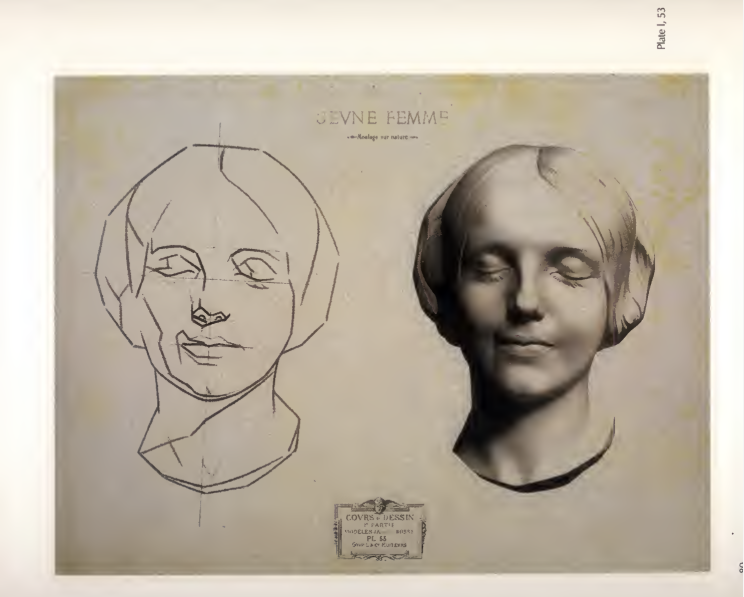
The book containing the image of the mask was published in 1867, while the legend of the Unknown Woman begins with her alleged suicide in the late 1880s. In other words, the “death mask” had existed for nearly twenty years before she was supposedly found and cast.
One of the most kissed faces in the world
In 1960, the Norwegian inventor Åsmund S. Lærdal introduced the first model of his CPR training manikin, now known as Rescue Anne, Resusci Annie, or Little Annie—a manikin designed to teach CPR to both professionals and the public.
Lærdal chose a female face because a male version might intimidate men who would need to “kiss” it (i.e., perform mouth-to-mouth resuscitation). Mouth-to-mouth is also known as “the kiss of life,” hence the kissing reference.
The manikin’s face was modeled after the Unknown Woman of the Seine. Her feminine features and serene expression gave the manikin a human quality and symbolic weight—reviving the one who, according to legend, died.
Lærdal’s CPR manikin has now trained over 500 million people worldwide. Between 2–5 million people learn CPR every year, and those skills have helped save up to 2.5 million lives.
In other words, the Unknown Woman has become one of the most kissed faces in the world.
And if you, like me, are now humming Michael Jackson’s Smooth Criminal, the lines “Annie, are you OK? Are you OK, Annie?” come directly from American CPR courses, where participants were taught to check for consciousness by asking, “Annie, are you OK?”
It all began as a clever marketing trick that then took on a life of its own—becoming a cultural icon and, today, helping to save lives across the world.
You might think this is a strange post to share just before Christmas, but my Christmas present to you—besides what I hope is an interesting read—is a reminder to take a CPR course, for example through the Red Cross.
There are both in-person and online options.
Wishing you a merry—and safe—Christmas!
Can you perform CPR? Have you ever had to use those skills?
A short story with Quinley & Herrow
Who are Quinley and Herrow?
In Coffinfolk Café’s stand alone short stories, you’ll meet two most unlikely friends:
Quinley – Coffinfolk’s café host. A young woman who loves life just as much as she loves exploring the cultural heritage of death and sharing advice, information, and insights that can help people – whether they are facing their own encounter with Death or living with grief.
Herrow – Death himself. He may look frightening in his black cloak, but beneath the bones is a kind soul who enjoys a cup of coffee and sharing experiences gathered from every corner of time.
You can find a longer introduction + a short story about their first meeting HERE
“One of the World’s Least-Kissed Faces”
Narrated by Quinley
Everything happened so fast.
Herrow and I were standing by one of the bookshelves in the café. I had just set up a postcard I’d framed from a friend who now lived in Paris. The postcard showed “L’inconnue de la Seine”—the Unknown Woman of the Seine.
I had sent her a picture of myself proudly holding up my certificate from a CPR course I’d taken with the Red Cross, and she replied with a cryptic: “I know exactly what to send you! You might have just given an artwork the ‘kiss of life.’”
A few days later, the postcard arrived in my mailbox.
The Reaper had just begun telling me about people’s views on death in Paris at the end of the 19th century when we heard worried voices behind us, followed by a crash and a scream.
When I turned around, an elderly man was lying unconscious on the floor, his wife kneeling beside him.
“Peter? Peter!” She patted his cheeks, but he didn’t respond. “He—he’s not breathing! Help!”
I rushed to his side. No breathing. No pulse.
“Call an ambulance.”
She nodded and, with shaking hands, fumbled through her purse for her phone. Another guest helped her stand so she could talk to the emergency dispatcher while I called out to the room, asking if anyone could do CPR. A dozen pairs of eyes looked at me, then at each other, as if waiting to see whether someone else would act. From a corner, a man stood up and hurried over.
For a moment, I worried he might hesitate to give another man mouth-to-mouth, but he knelt by the patient’s head without questioning it.
“You start compressions, then we’ll switch.” He sounded so calm. I could barely hear my own voice counting aloud over the pounding in my ears.
“5, 6, 7…”
My gaze drifted to the bookshelf where the Reaper still stood, just where I’d left him.
Over his shoulder, I saw the postcard with the young woman. The contrast between the one who gathers lives and the one who saves them felt almost overwhelming in the gravity of the moment. Herrow’s face was as still as ever, while the woman’s gentle smile on the postcard seemed to speak to me without words: “Keep going. Don’t give up. Help is on the way.”
The man’s wife had finished the call and turned toward Herrow too.
“Don’t you touch him, you hear me?” She took a few unsteady steps toward the Reaper before another guest stepped in and guided her to a chair.
I knew Herrow had no power to save or take a life. His job was to collect and guide.
It felt as though my partner and I worked on the man for hours instead of minutes before we finally heard approaching sirens.
When the paramedics came in and took over, I staggered toward the counter to give them space. The guest who had helped me laid a hand on my shoulder. I felt the warmth of his steady grip while every voice around us blurred into a distant murmur.
I don’t remember what I tried to say as the man was rolled out on a stretcher, his wife following closely behind.
A few minutes later, Harley rushed in and wrapped their arms around me.
“I came as soon as I heard. Are you okay?”
I nodded slowly, though I was still shaking like a leaf. “That’s the adrenaline. You’ll probably crash soon—maybe even need a nap. Want me to call you a taxi?” Go home? Not a chance.
“I’m staying here.” My tone left no room for debate. Harley nodded.
“Good. Then I’ll keep an eye on you.”
It wasn’t just my boss who kept watch over me as I curled up on one of the sofas with a cup of hot chocolate and a book. Grimmy, our little church grim, clung to me like a burr all afternoon. A black, fluffy, purring burr. His large amber eyes followed me whenever I left the sofa to refill my cup or fetch a new book. Not even the smell of warm muffins could lure him away—and that’s saying something. I scratched the mysterious creature behind his ears, and he chuffed like a tiny tractor.
But another mysterious being was missing. I hadn’t seen Herrow since the ambulance arrived.
“Herrow?” I whispered into the air beside me. “Herrow, come back. Please?”
I sensed his familiar scent first—lilac and old books. Slowly, he began taking shape next to me on the sofa. I took one of his thin hands between mine. “Don’t scare me like that.” I squeezed his hand harder.
“I worried that’s exactly what I’d done,” he said softly. “That death came a bit too close—that you needed distance from… what I am. What I do.”
I slowly shook my head.
“Is he dead—the guest?” I dreaded the answer.
“He lives. Sore and shaken, but he lives.”
A stone dropped from my chest. He had made it!
I leaned forward and kissed Herrow on the forehead. The Reaper tilted his head, clearly puzzled.
“What was that for?”
“She’s one of the world’s most kissed faces—and she’s saved millions of lives.” I nodded toward the postcard on the shelf. “If our guest hadn’t been saved, I knew he’d be in safe hands and good company. You’ve gathered billions of souls. You don’t deserve to be one of the world’s least-kissed faces. I’m just trying to balance the numbers a little.”