
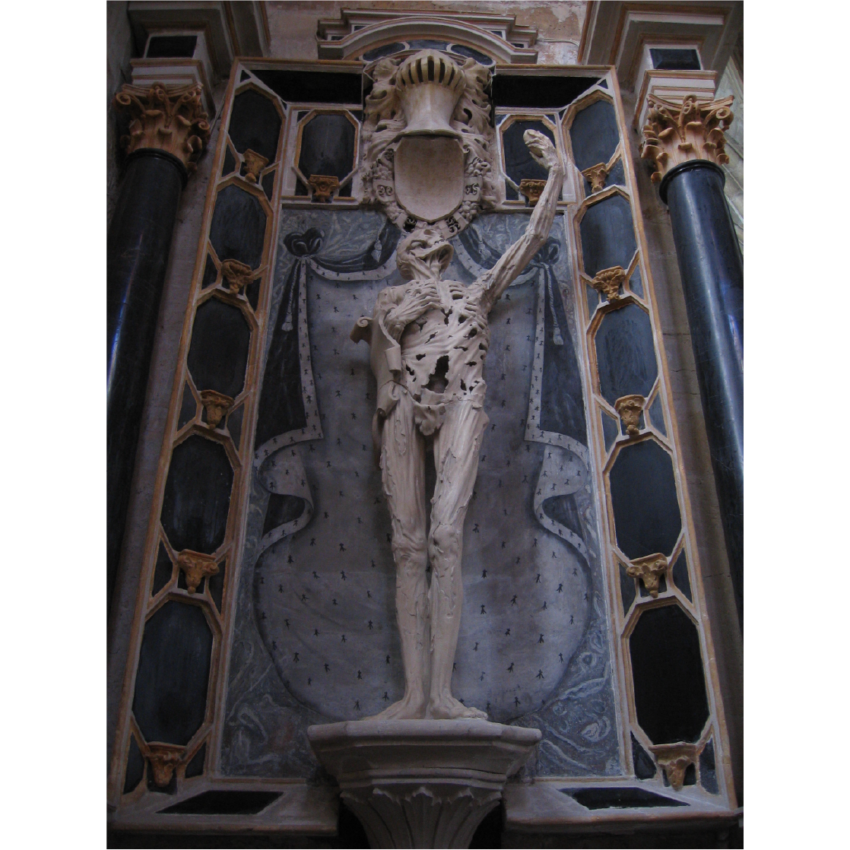
Transi, also known as cadaver tombs or cadaver monuments, were a way of adorning a grave with a sculpture that differed greatly from the types of grave monuments we are accustomed to seeing today in cemeteries or burial vaults.
Instead of depicting the deceased as peacefully resting, the sculpture portrays the person’s decaying corpse or skeleton. It served both as a graphic reminder of life’s fragility and the impermanence of the human body, and as a more frightening reminder of what awaited after death: the torments of Purgatory.
Image: René de Chalon, sculpted by Ligier Richier (1544-1557)
The Image of Death in Medieval Europe
One thing was certain—death was never far away.
A small wound could lead to an infection that claimed a life. A new mysterious illness could emerge out of nowhere, sweep across the continent, and reap millions of lives.
After the Black Death (1347–1351), which wiped out somewhere between 30–60% of Europe’s population, Death became more than just a fate or a punishment delivered by a god or a folkloric being. Death became a figure.
The art form Danse Macabre (The Dance of Death) spread across Europe through church murals, manuscripts, and literature. It depicts Death—most often as a skeleton, sometimes carrying a scythe, sometimes not—dancing with people from all levels of society: popes and kings, peasants and children alike. It served as a reminder that death makes no distinctions.
Death does not judge—it comes for everyone, regardless of wealth, piety, or power.
The Boundary Between the Living and the Dead Was Blurry
Even after death, it was believed that the body retained a certain degree of awareness. During the first year after burial, or until all soft tissue had decomposed, the body was thought to still feel what the soul experienced in the afterlife.
Because knowledge of the human body was limited, it also happened that the “dead” sometimes came back to life—sometimes before being placed in the coffin, sometimes even after burial.
One such example is Margorie McCall, known as the woman who was buried twice.
first burial, she awoke when grave robbers attempted to cut off her finger to steal a ring she had been buried with. One might wonder who received the greater shock.
It is said that her husband, himself a doctor, died of shock when she walked through the front door.
Margorie remarried and had children before she eventually died and was buried a second time. Her gravestone reads: “Lived once, buried twice.”
Transi Were for the Wealthy and Influential
Commissioning a transi sculpture was an expensive undertaking that also required significant space in a church or cemetery. In other words, it was something only the wealthy or influential—such as high-ranking members of the Catholic Church—could afford or be honored with.
John Fitzalan, 7th Earl of Arundel and 4th Baron Maltravers, went all in and commissioned a sculpture of himself both as deceased (yet intact) and as an emaciated corpse. It must have been a profound experience to see oneself depicted in such a manner.
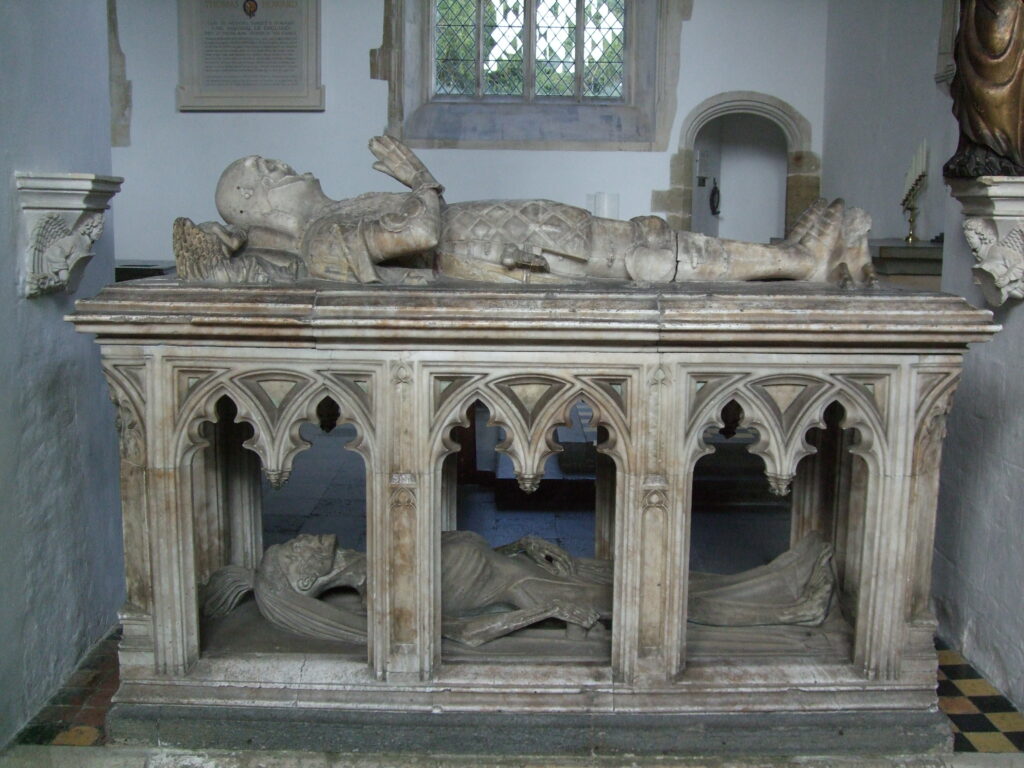
Image: John Fitzalan, 7th Earl of Arundel, 4th Baron Maltravers
Fitzalan Chapel, Arundel Castle, Sussex, England
Prayers for the Souls in Purgatory
According to Catholic belief, the soul of the deceased passes through Purgatory, where it is cleansed of sins before entering the Kingdom of Heaven. This process is extremely painful, and as mentioned earlier, medieval belief held that the body retained a fragment of awareness. This is why many transi sculptures depict faces twisted in agony.
Some transi feature a poem or verse addressed to the visitor, often along the lines of:
Remember me as you pass by
As you are now, so once was I
As I am now, so you must be
Prepare for death and pray for me
A reminder that we will all face death, and an encouragement to pray for the person resting in the grave. These prayers were believed to help the soul pass through Purgatory more quickly—so reminding people of their own fate was not an entirely selfless act.
The Macabre Art Form Met Its Own Death
After the Reformation, demand for transi sculptures largely disappeared, as Protestant countries no longer believed in Purgatory. Instead, the soul was thought to go to Heaven or Hell, depending on how one had lived.
Art forms come and go, but Death remains.
It was during this time that Death increasingly took on the familiar form many of us recognize today: the classic Grim Reaper, clad in a black cloak with a faithful scythe at his side.
I find transi incredibly beautiful in their own macabre way, and I am also deeply fascinated by memento mori art in general.
My favorite (what—doesn’t everyone have a favorite transi?) is René de Chalon, sculpted by Ligier Richier (1544–1557), now standing in the Church of St. Étienne in Bar-le-Duc, France.
Originally, the sculpture held René de Chalon’s embalmed heart, which I think takes the concept to entirely new heights. For understandable reasons, only the sculpture remains on display today.
Here is a link to a YouTube Short showcasing the sculpture:
https://www.youtube.com/shorts/aJZ0r5MsWQI
What do you think of transi—art or nightmare?
A short story with Quinley & Herrow

Who are Quinley and Herrow?
In Coffinfolk Café’s stand alone short stories, you’ll meet two most unlikely friends:
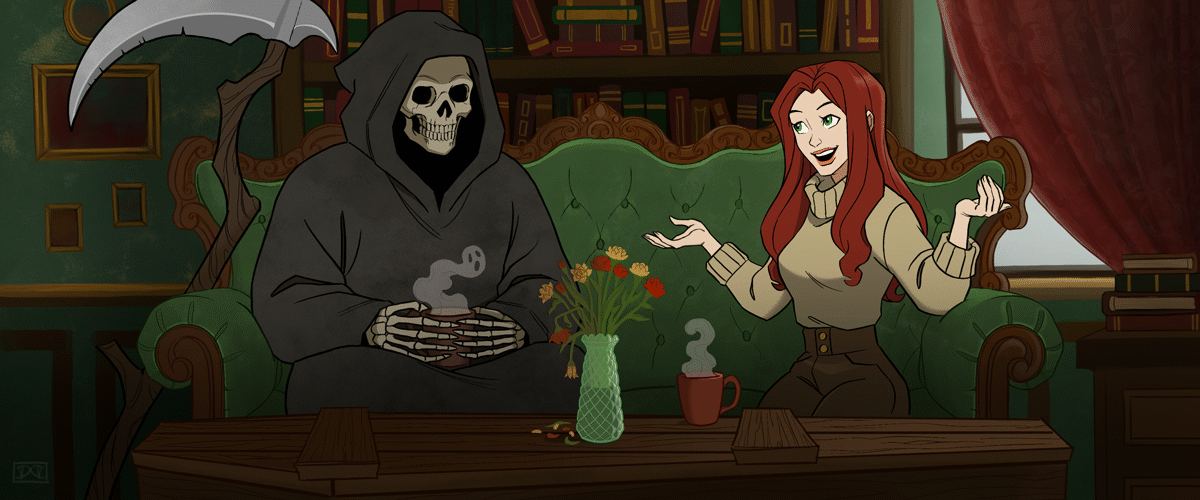
Quinley – Coffinfolk’s café host. A young woman who loves life just as much as she loves exploring the cultural heritage of death and sharing advice, information, and insights that can help people – whether they are facing their own encounter with Death or living with grief.
Herrow – Death himself. He may look frightening in his black cloak, but beneath the bones is a kind soul who enjoys a cup of coffee and sharing experiences gathered from every corner of time.
You can find a longer introduction + a short story about their first meeting HERE
“A Transi Among the Teacups”
Narrated by Quinley
Here at the café, we sometimes receive requests from our guests. Most often, a small group wants to gather here to drink a cup of coffee after a funeral, or to hold a private moment of remembrance on the anniversary of a loved one’s death. A couple of times we’ve hosted birthday parties, and once even a civil wedding!
Vera, however, had a very different kind of question.
She rents a workspace in a pottery studio located in the same alley as Coffinfolk, a place she enjoys very much—but as Vera put it: “Not everyone appreciates finding a rotting corpse among the teacups.” So some creations are better suited to take shape here instead.
Many of the other guests who came and went during Vera’s visits were curious about her work as she sat in her corner, quietly creating. It was fascinating to watch her transform a formless lump of clay into parts of a skeleton, rendered with incredible detail despite the tiny scale. I had never heard of transi sculptures before Vera told me about their history and symbolism.
Herrow was as always deeply interested in how humans engage creatively with death, and gladly served as a model when Vera wanted to study the many small bones in his hand. It took a few attempts, but eventually she was satisfied, carefully placing the tiny bones onto the tray beside her.
“I don’t understand how sculptors managed this in stone,” Vera murmured as she gently adjusted yet another finger bone. “One advantage of clay is that you can start over when something goes wrong. Stone doesn’t allow that kind of margin for error at all.”
“Clay may be more forgiving,” Herrow chimed in, taking a sip from his coffee, “but it still demands its fair share of knowledge and skill.”
“And not to mention luck, when it’s time for the kiln…” Vera giggled, tucking a moss-green strand of hair behind her ear.
When Vera wasn’t here working on her piece, we stored her creation in Harley’s office. Her plan was to create a small series of transi sculptures, and I hoped she would want to exhibit them here once they were finished. At Coffinfolk, we welcome rotting corpses among the teacups — at least in transi form! I truly have a wonderfully strange job. Ha, ha!
The next time I caught sight of Vera’s green mop of hair over in her creative corner, she sat frowning at her phone, scrolling while her other hand pressed against her lower ribs.
“Are you in pain?”
“Hm? Oh, no. Research.” Vera held up her phone. On the screen, I saw a zoomed-in image of a skeletal ribcage. “I can’t find a decent image from the right angle… Am I the only one who wonders what the ribcage looks like from the inside?” She laughed helplessly and placed the phone down on the coffin lid.
“Have you asked Herrow?” I pointed my thumb over my shoulder toward the reaper, who had just appeared behind me. Vera’s gaze flicked between the two of us.
“Can I…?” she whispered, as if Herrow wouldn’t hear her perfectly well anyway.
“Of course! Quinley, would you hold this for me, please?” Herrow handed me his scythe. “And this as well.” He draped his black cloak over my shoulders. The fabric smelled of herbs and old books. I pulled it closer around me and leaned against the sturdy scythe, just as Herrow usually did. Who would have thought it could feel so safe—almost cozy—to act as a coat rack for Death. My existence is certainly as wonderfully strange as my job.
With a soft clicking sound, Herrow walked over to Vera and lay down on the floor, allowing her to see the inside of his hollow ribcage.
By pure reflex, Vera picked up her phone and took a reference photo. When she flipped to the image, all that appeared was the café’s worn wooden floor.
“Take your time, I’m in no hurry,” Herrow chuckled, performing his version of a wink. “As long as Quinley can supply me with coffee, that is.”
“At your service, Mr. Death,” I said, making an overly dramatic bow before fetching the requested cup of black coffee.
When I returned, the shock seemed to have faded, and Vera’s skilled fingers were already shaping the first arches of the ribs.
“I understand this isn’t for everyone,” she said, “but there’s something so beautiful about the human body — even when it’s… um…” She trailed off.
“Imperfect?”
“Yes, exactly. I mean, the sculptures we see on graves today are beautiful, but there’s something about transi that feels so deeply human and stripped bare. Literally. If anything, death is proof that something once lived, that it existed. That we’re part of a cycle that reminds us to live while we live — before we continue to exist in another form.”
“Before we become memories?”
Vera nodded as she carefully attached thin strips of clay resembling tissue that still clung to parts of the sculpture’s decaying body.
“As you are now, so once was I,” Herrow said, looking at me through his empty eye sockets.
“As I am now, so shall you be,” he continued, turning toward Vera.
“Be ready for death, and follow me.” The reaper slowly sat up.
“Follow you… to the afterlife?” Vera whispered, gazing at her nearly finished sculpture.
“In time. For now—the owen. There are freshly baked muffins.”