

We laugh when we should really be crying.
We make jokes in our darkest hours – but why?
Faced with the choice of falling apart or fighting pain with darkness, we color our humor as black as grief itself. Sometimes, a laugh is the only light we can find in the shadows.
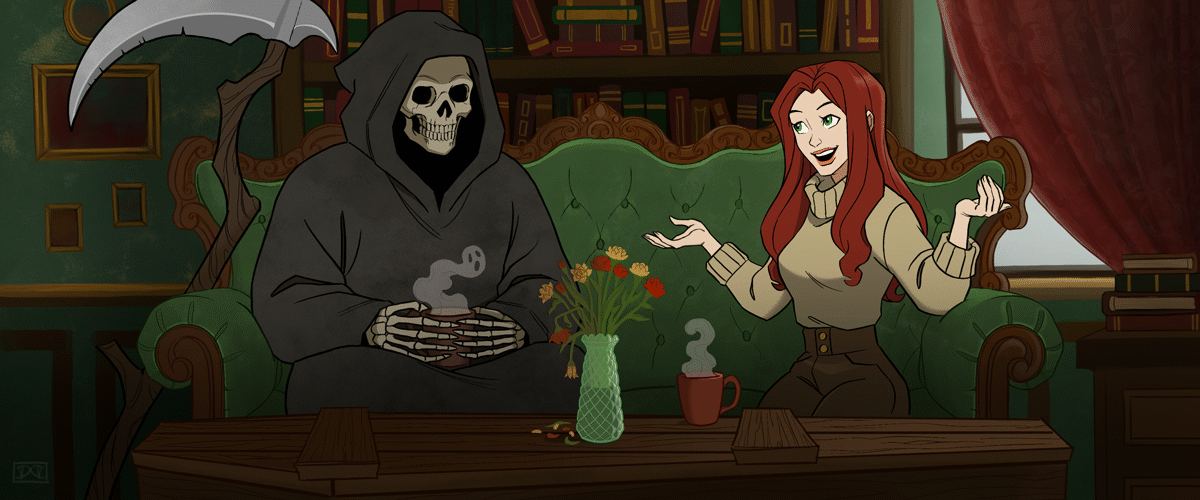
Image: Courtesy of comic artist TonyBTS2
Laughing at the dark – why do we do it?
Defense mechanism: Laughing can be a way to release emotions instead of breaking down in tears or lashing out in anger. It creates distance, gives us a breath of air before we dive back into the heavy feelings.
Connection: Laughing together builds a sense of community – even in tragic or frightening circumstances. Making others laugh can also lift your own mood and morale.
Control: Few moments make us feel so powerless as when we face the death of someone close – or our own mortality. Finding something humorous in the situation can restore a sense of safety, power, or control.
Disarming: Being able to smile – or even laugh – when talking about death and grief can take away some of the fear. That’s why here at Coffinfolk we try to weave in a little humor, when it fits. Besides, both myself (Harley) – and my characters Quinley and Herrow – have a soft spot for that kind of humor.
Laugh or perish – dark humor as survival strategy
As far back as the Middle Ages, dark humor was a way to cope with grief and lift spirits during both personal loss and societal catastrophes like the Black Death. Folk songs mingled horror with jokes, and in art, the Danse Macabre spread across Europe: Death inviting people of every age from all walks of life to a final dance, celebrating life as much as the inevitable end.
Today, paramedics, firefighters, police officers, veterinarians, criminal lawyers, and countless others who encounter trauma in their work rely on dark humor as a coping tool.
The military, too, has long used it as a lifeline. The greater the danger, the darker the joke.
Gallows humor – when a good laugh didn’t save a life
“You want to look your best when you go,” said the man about to be hanged as he straightened his shirt collar.
The term gallows humor comes from the sharp, often macabre remarks of the condemned before, or on their way to, their execution. Likely, it was their way of warding off panic, powerlessness, and the inescapable presence of Death.
Humor at funerals – joking to honor, laughing to remember
Jokes and laughter may not sound like a natural part of funerals to us Swedes, but several cultures embrace humor as part of saying farewell. Maybe it could even inspire your own last wishes?
Ireland: The Irish Wake
At traditional Irish wakes, family and friends gather around the deceased before burial. They drink, share stories, and often make jokes about the departed – sometimes even harmless pranks, like putting a pipe in the mouth of someone who was never seen without one in life.
Laughter balances grief, airing out heavy feelings and remembering the person as they were in life – not just in death.
USA / UK / Ireland: Roast-style eulogies
In more liberal or humor-loving families, eulogies mix heartfelt memories with embarrassing or funny stories. The intent is still to honor, not insult.
Sometimes, the deceased themselves set the tone with humorous requests about their funeral, coffin, or even tombstone. The comedian Spike Milligan, for instance, had his gravestone inscribed with the words: “I told you I was ill.”
Dark humor isn’t for everyone – and that’s okay. 🖤
Those of us who appreciate this kind of humor, even in our darkest times, aren’t mocking grief or running away from it. We’re acknowledging how absurd life (and death) can be – and finding strength in laughter to endure life’s heaviest moments.
Laughing at Death isn’t about taking life less seriously – quite the opposite. It’s about daring to face the inevitable with a smile, reminding ourselves that we are alive, here and now.
What’s your own relationship with dark humor – and with laughing at Death itself?
A short story with Quinley & Herrow

Who are Quinley and Herrow?
In Coffinfolk Café’s stand alone short stories, you’ll meet two most unlikely friends:
Quinley – Coffinfolk’s café host. A young woman who loves life just as much as she loves exploring the cultural heritage of death and sharing advice, information, and insights that can help people – whether they are facing their own encounter with Death or living with grief.
Herrow – Death himself. He may look frightening in his black cloak, but beneath the bones is a kind soul who enjoys a cup of coffee and sharing experiences gathered from every corner of time.
You can find a longer introduction + a short story about their first meeting HERE
“Black cloak. Black coffee. Black humor.”
Narrated by Quinley
Before I met Herrow, I imagined Death as a quiet, emotionless figure who dutifully carried out his job of escorting souls to eternity. I didn’t think he reveled in people’s fear or grief—more that he simply didn’t feel or think much about it at all. How wrong I was! Herrow is wise, compassionate, and incredibly funnyHe has a dry, dark sense of humor, and he loves to joke at his own expense.
I keep a notebook where I jot down his wry remarks. Who knows—maybe one day we’ll have enough to make a whole book out of them.
Here are some of my favorites from just last week:
"Say what you will, but at least I travel light."
"Clothes never fit me quite right… but everybody looks good in black."
"It’s not a stressful job – I will come for each one of you, eventually."
"Most people are less afraid of me once we’ve talked a while. I’ll have a coffee—what do you want? My treat."
"I tried getting a gym membership. They said it wouldn’t make a difference. Good thing I’ve got a solid skeleton."
"I’m not the end. I’m the hand you hold on the way there. Don’t be nervous—hold as tight as you want. I won’t fall apart."
"I’m punctual. It’s you people who complain that I’m early."
"I don’t play favorites. I meet everyone with the same quiet respect. Those who don’t try to smash me to pieces also earn my eternal gratitude. Getting 206 bones back in place takes a while."
"I may look like Death—but I hope I don’t feel like it."
"Death isn’t dangerous. Just… unfamiliar. That’s why I’m here. The best coffee in town is a bonus."
"Quinley says I’ve got a heart of gold. Somewhere. Probably in the lost-and-found bin."
"No one walks alone. Not on my watch—and I’m always on duty. Good company is guaranteed!"
Herrow’s humor didn’t just amuse himself—I could see how guests dared to lower their guard and exchange a few words with the Reaper over a cup of coffee.
Sometimes, you need to be able to joke about something as heavy and serious as the end of life—perhaps all the more when you are Death himself.