
On February 17, 2026, the celebration of the Chinese New Year began, ushering in the Year of the Horse.
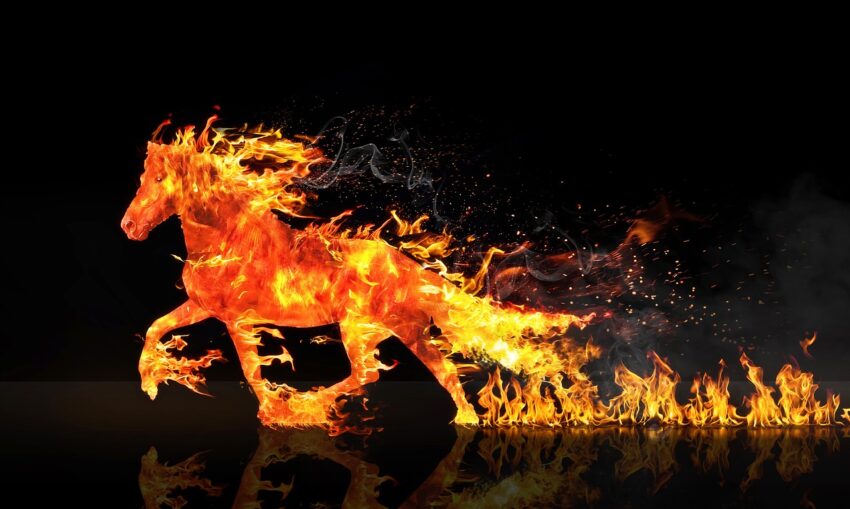
In the Chinese calendar, each animal is paired with one of the five elements, and this year it is the Horse combined with Fire — the Fire Horse.
The Fire Horse is associated with strong energy and drive, independence and courage, rapid change, optimism, and faith in the future.
Perfect qualities when we are working to accept our own mortality and live life to the fullest,
despite knowing that death always follows in our tracks — sometimes at a full gallop.
In this post, you’ll read about horses from religion and folklore that trot alongside both gods and humans through myth, life, and death.
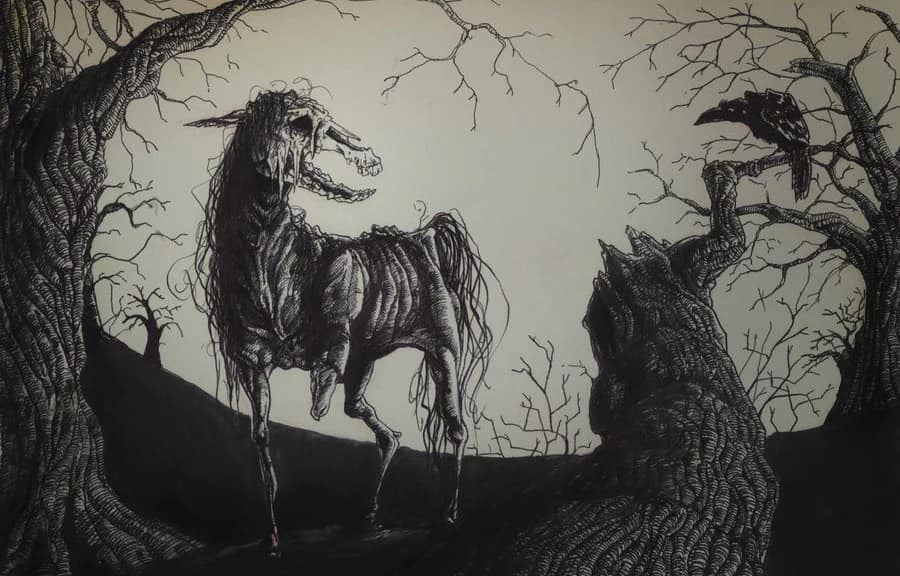
Helhesten – the horse of death that watches over the graveyard
In Old Norse belief, the death goddess Hel rode a three-legged horse named Heldrasill.
After the Nordic countries were Christianized, the image of Helhesten changed, but the name remained.
Now the horse had a new rider — no longer Hel, but Death himself.
Like other kyrkogrimmar (animals buried in a new churchyard before the first human burial), Helhesten guarded the graveyard and protected those laid to rest there, ensuring they could rest in peace.
Encountering the black, three-legged — sometimes headless — horse was not only a terrifying sight; it was an omen foretelling illness, misfortune, or your own death.
In Danish, the expression “Han går som en helhest” (“He walks like a helhest”) is still used today, meaning that a person limps or staggers forward, much like the three-legged Helhesten.
You can read more about the church grim in Sweden and other parts of the world HERE.
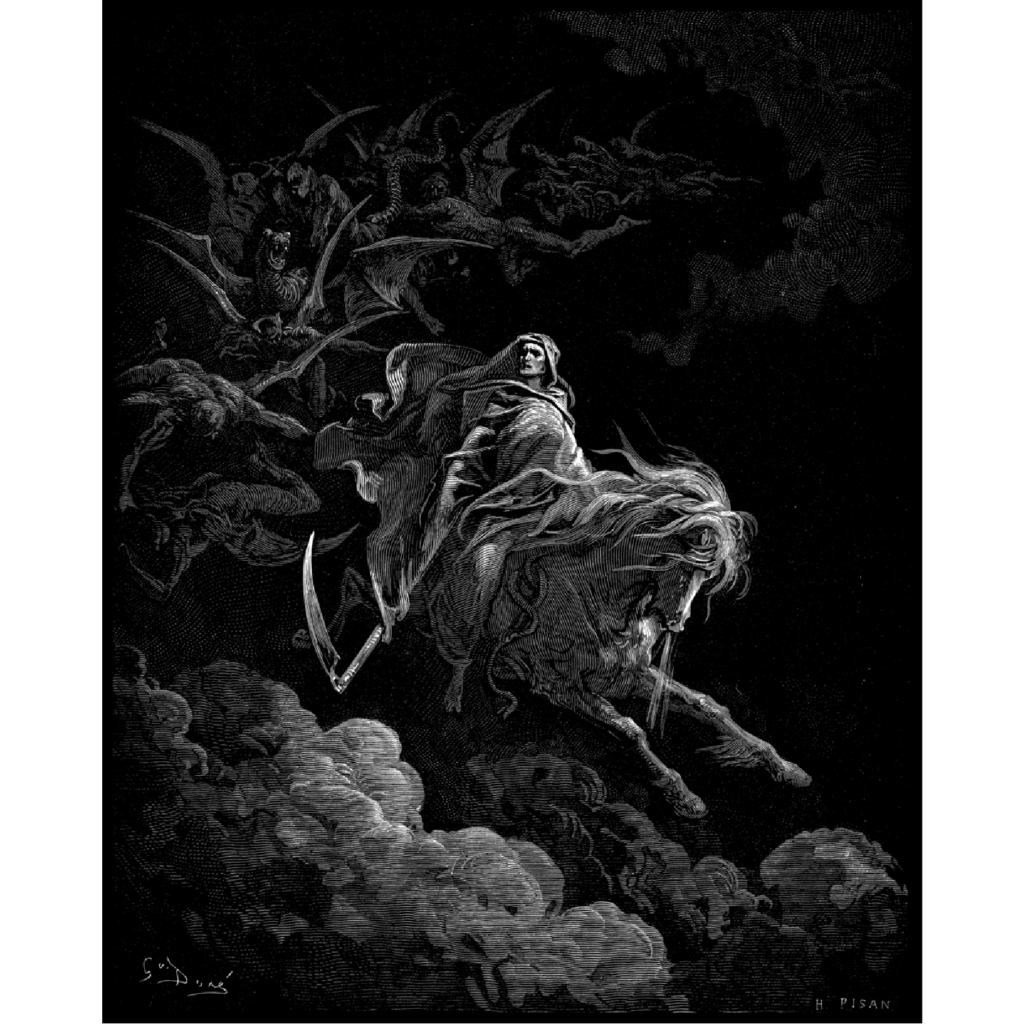
The Pale Horse – the fourth steed of the Apocalypse
In the story of The Four Horsemen of the Apocalypse, from the sixth chapter of the Book of Revelation, we encounter symbolic figures revealed to the apostle John in a vision.
Together, they represent the forces driving the world toward its end: war, suffering, scarcity, and death.
“I looked, and there before me was a pale horse! Its rider was named Death, and Hades was following close behind him. They were given power over a fourth of the earth to kill by sword, famine and plague, and by the wild beasts of the earth."
– Revelation 6:7–8
Like its rider, Death, the horse bears a sickly, pale yellow-green hue — a color associated with that of a corpse. In some modern depictions, the horse is given a brighter, more vivid green tone.
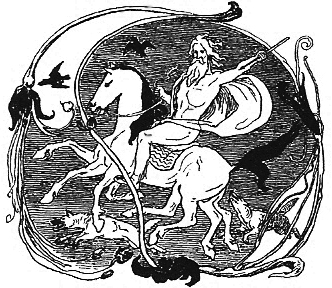
Sleipnir – the stallion with divine horsepower
Odin’s eight-legged gray horse, capable of running faster than the wind and carrying his rider across land, sea, and through the air. He can also move freely between the nine worlds, including Helheim, the realm of the dead.
Like many figures in mythology, Sleipnir has an intriguing lineage.
His parents are Loki (who gave birth to the horse after transforming himself into a mare) and the giant stallion Svaðilfari. He is the half-sibling of Fenrir the wolf, the Midgard Serpent, and the death goddess Hel.
It was not only Odin who rode the magnificent Sleipnir — those who fell in battle were also allowed to mount him and ride to Valhalla in Asgard.
Valhalla was Odin’s dwelling, where he gathered skilled warriors for his army in preparation for the final battle of Ragnarök.
It was during Ragnarök that Sleipnir ultimately met his fate. Together with Odin, he was devoured by Fenrir.
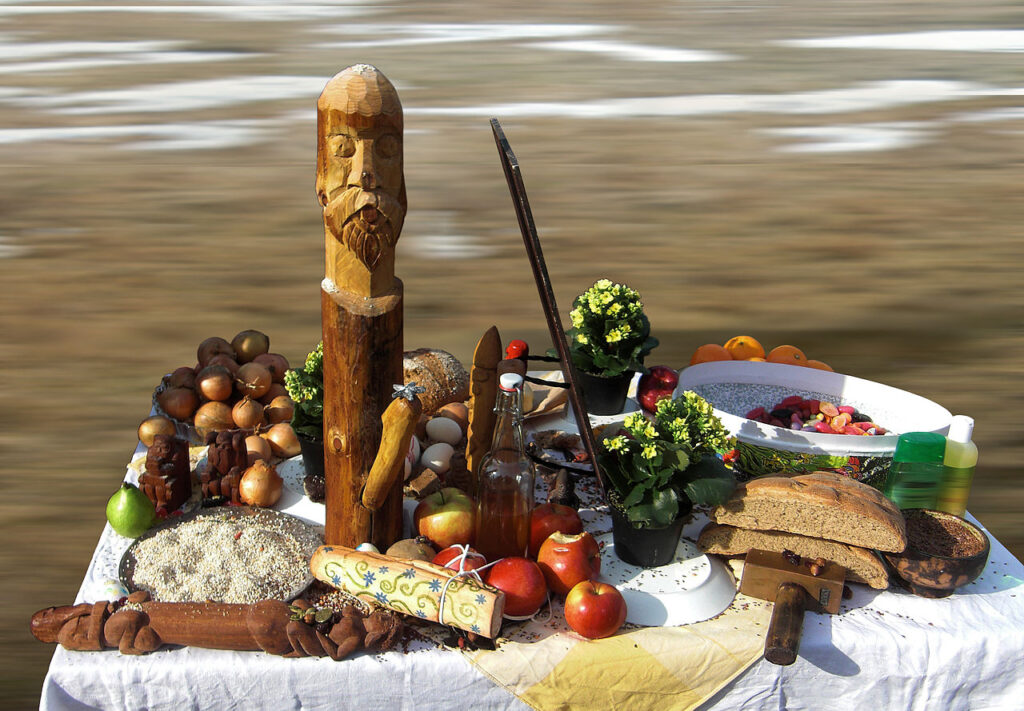
Horse sacrifices and grave horses – a macabre act of love
Here in Sweden, horses have been found buried in or beside human graves as early as the Late Iron Age. Even then, horses held a central place in everyday life.
It may sound macabre today, but allowing the deceased to bring their horses with them into the afterlife was an act of great care and respect. In addition to the animals themselves, beautifully decorated bridles and saddles were often buried as well.
Similarly, horses were sacrificed during annual blóts to appease the gods with the most valuable offering one could give. It was believed that horses possessed supernatural powers — even in death.
The meat was then prepared and consumed during a ritual feast, a practice that was later forbidden with the arrival of Christianity.
“Death’s pale horse looked up from its oats and gave a little whinny of greeting. The horse’s name was Binky. He was a real horse. Death had tried fiery steeds and skeletal horses in the past, and found them impractical, especially the fiery ones, which tended to set light to their own bedding and stand in the middle of it looking embarrassed.”
– Terry Pratchett – Reaper Man
Horses are amazing creatures. I hope that you who are reading this will one day experience the special bond you can form with a horse. They don’t just see you — they see your soul.
If you are mortally afraid of horses, then I instead wish you a wonderful Year of the Fire Horse!
What kind of relationship do you have with horses — both the real ones and the more supernatural kind?
A short story with Quinley & Herrow

Who are Quinley and Herrow?
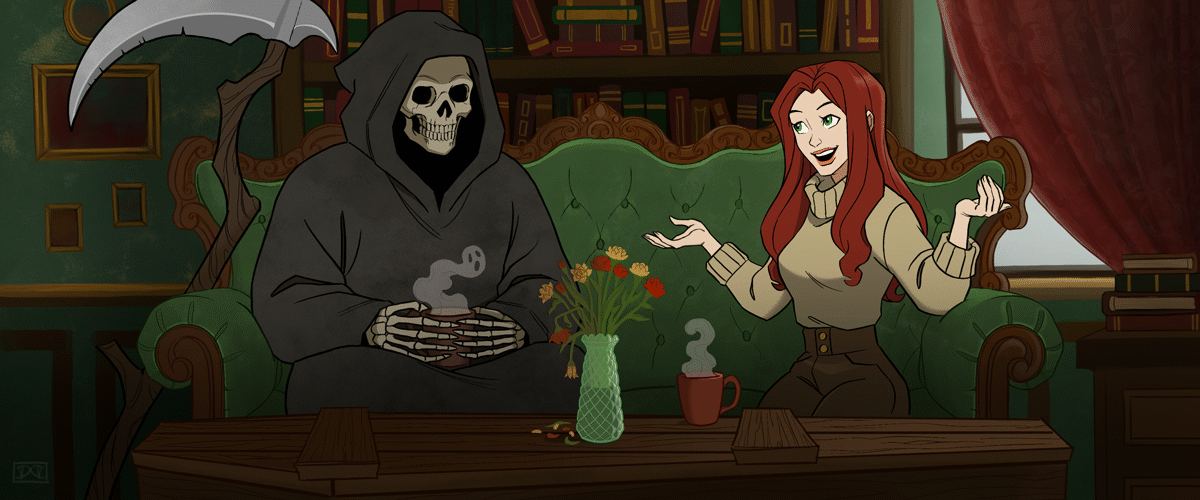
In Coffinfolk Café’s stand alone short stories, you’ll meet two most unlikely friends:
Quinley – Coffinfolk’s café host. A young woman who loves life just as much as she loves exploring the cultural heritage of death and sharing advice, information, and insights that can help people – whether they are facing their own encounter with Death or living with grief.
Herrow – Death himself. He may look frightening in his black cloak, but beneath the bones is a kind soul who enjoys a cup of coffee and sharing experiences gathered from every corner of time.
You can find a longer introduction + a short story about their first meeting HERE
“Death’s (Im)possible Steed"
Narrated by Quinley
What do you say when Death asks you to act as a taste consultant? I said “Yes,” so here I am.
Stardust, a gentle mare who never turned down a bit of pampering or a ride out, plodded along at my side and stopped, as if on cue, by the mounting block so I could swing into the saddle.
“Good girl.” I bent down and patted her neck. Her brown coat gleamed in the light from the lamps in the ceiling. I much preferred riding out in the forest, but in this snowstorm I was grateful the farm had an indoor arena I could borrow.
As we walked along one of the long sides of the arena, I glanced up at the large clock hanging on the wall. 7:00 p.m. Herrow had said he would be here by now, and if there’s one thing the Grim Reaper is, it’s punctual.
I had barely finished that thought when Herrow took shape in the middle of the arena. But he wasn’t alone. Beside him stood something that had once been a horse, but now looked more like a reanimated corpse. The horse was black as night, missing a leg, and worst of all—it was headless.
I gasped. Stardust came to a dead stop and began backing away, trying to put as much distance as possible between herself and the terrifying creature.
“Herrow! What the he—what is that?!” I tried to calm Stardust, but I could feel my own heart pounding in my chest. Herrow’s horse radiated death and misery.
“I overheard you and Hannah talking about horses earlier at the café and got a bit inspired. Thought I might get myself a steed too. What do you think of my helhest?”
I shook my head. Stardust backed up until her hindquarters were pressed against the wall.
Herrow looked up at the helhest.
“Perhaps you’re a bit too much after all, my friend. Very well—return to your duties in the churchyard until we meet again!” The Reaper clapped his hands, and the horse vanished into thin air.
A new calm washed over us once the ominous horse was gone. Stardust took a few tentative steps toward Herrow and stretched out her muzzle so he could greet her.
“Have I exhausted my goodwill with both of you, or would you like to see more candidates?” Herrow looked almost embarrassed—about as embarrassed as a skeleton can look, that is.
“As long as they’re not quite so horrifying,” I said. Stardust agreed with a soft snort.
“That’s the spirit, ladies! Let’s see…” Herrow clapped his hands again, and another horse appeared.
This one was at least intact, but its coat had a sickly greenish-yellow hue that almost made me nauseous. The stench that rose from it whenever it moved didn’t help. The horse’s milky eyes met mine, and a chill ran down my spine.
“Herrow…?” I had to clear my throat before continuing. “Is that… um… a horse from the Bible…?” I almost dreaded the answer.
“Indeed! A true classic. You know the fourth rider was the only one named—Death.” Herrow straightened a little.
“Mhm. One of the Four Horsemen symbolizing the end of the world…?”
“Yes, exact—” He paused. “It’s the color, isn’t it?” He snapped his fingers, and the horse’s coat shifted to a bright green. “Better? A more modern feel.”
I bit my lip, searching for the right words.
“No, it’s not the color, it’s more—” I gestured vaguely at the entire apparition. “The symbolism. And the smell.”
Herrow leaned on his scythe and traced a finger along his jawbone.
“You mortals do have a keen eye for detail, that’s true. Oh, I know!”
Death clapped his hands, and a third candidate announced himself with a thunderous crack that sounded more like lightning than hooves.
Stardust lifted her head, ears pricked, and I’m fairly sure my eyes grew as wide as saucers as we took in the sight before us. You don’t see an eight-legged horse every day.
The grey stallion was clearly aware of his status and posed proudly at Death’s side.
“Nordic style and power in perfect balance. And he’s escorted fallen warriors for centuries already, so he knows much of the job description. Isn’t that right, Sleipnir?”
The magnificent horse tossed his head and pawed the ground, his eight hooves striking in perfect rhythm. “Well, of course one must take a test ride when given the chance!” Herrow laughed, swinging smoothly into the saddle.
I barely had time to blink before they were at the far end of the arena. Another blink, and they were back in front of me and Stardust.
“What speed!” Herrow whooped, adjusting the hood that had slipped off his skull. “This would be quite something to be collected by, wouldn’t it, Quinley?”
“Haha, yes, well… but—” Sleipnir gave me a skeptical look. “I just think death can already come suddenly enough for people as it is. They probably need all the time they can get to settle into their new reality.” I shifted uneasily in the saddle, worried I’d offended a divine horse.
“You may be right,” Herrow said, stroking Sleipnir’s sleek neck. “You’re perhaps a bit overqualified for the task, my boy.”
“Like buying a Ferrari for a leisurely Sunday ride,” I giggled.
Sleipnir snorted, as if he found the comparison amusing as well. Herrow clapped his hands, and Odin’s grey steed vanished with another resounding crack.
“Well, that was the extent of my ideas,” Herrow shrugged.
“Come on—there’s room for one more here.” I patted Stardust’s back behind the saddle.
Together we trotted around the arena. Stardust was probably just as shaken as I was after everything we’d seen, but she was as sure-footed as ever. Herrow sat securely behind me, his scythe resting against his shoulder, his bony hands holding a gentle grip around my waist.
“You know, Herrow,” I said, “you don’t arrive with thunder and lightning. It’s more like you’ve always been with people—but it’s only at the end of life that they truly see you.” I glanced over my shoulder. Herrow tilted his head, listening. “You’re not always a frightening sight either. Some of us see you as a good friend, even while we’re still alive.” Herrow’s hands tightened slightly around me. “You’re a simple being, with your cloak and scythe. You’re just you. If you want a companion, it should reflect that.”
We slowed to a walk, and Stardust stopped with a contented snort. Herrow was back on solid ground before I was. He stroked the mare’s muzzle.
“I agree, Quinley. No point trying to fix what isn’t broken. You horses are like me—perfect just as you are.”
“Not to mention humble!” I giggled.
“Well, when one is as written about in history as I am—and these majestic creatures—it’s easy to let things go to one’s head,” Herrow chuckled, scratching Stardust between the eyes. She leaned into his touch and closed her eyes.
“That explains why cats are the way they are…” I whispered, not wanting to disturb the tender moment between my two more-or-less mythological friends.
“Exactly,” the Reaper chuckled. “As I said; perfection.”