

Halloween, pumpkins, costume parties, and spookiness.
All Saints’ Day, grave candles, memories, and stillness.
Whether you prefer lighting jack-o’-lanterns, grave candles—or both—this season is a time for togetherness and reflection. Two traditions, different in tone, yet both with light as their symbol against the darkness. So why do we celebrate them so differently?
Halloween – from Celtic harvest festival to Christian holiday
Halloween has its roots in the 2,000-year-old Celtic festival Samhain, which marked the Celtic New Year: the transition from summer to winter, from light to darkness, from life to death. It was believed that the veil between the worlds of the living and the dead was thinnest at this time, allowing spirits from the other side to visit our world. Families would invite the spirits of their deceased relatives to join in the great harvest feast.
People dressed in frightening costumes and lit large bonfires—much like our Swedish Walpurgis Night fires—to protect themselves from and scare away evil spirits.
When Christianity reached Scotland and Ireland, Samhain was labeled as a pagan, devil-worshipping tradition. Just like with other pagan celebrations— Yule (later Christmas), for example—a new holiday was created: All Hallows’.
The name Halloween comes from All Hallows’ Eve, which later became Halloween.
Samhain is still celebrated today. A modern example is the Samhuinn Fire Festival in Edinburgh, Scotland, organized by the Beltane Fire Society. The festival is a contemporary interpretation of Samhain and is celebrated with a spectacular performance of fire, music, dance, acrobatics, and mythological characters. The event takes place outdoors, and the audience is encouraged to come dressed in imaginative, Halloween-inspired costumes.
Read more about the Samhuinn Fire Festival: https://beltane.org/about-samhuinn/
“Trick or Treat” - from medieval door-knocking to modern candy hunts
The tradition of “Trick or Treat” began in medieval Britain during All Souls’ Day, when the poor went door-to-door asking for food. They would receive a type of small cake called a ‘soul cake’. In return, the beggar would include the donor’s deceased relatives in their prayers. Children also began dressing up and knocking on doors in hopes of getting food or coins. In exchange, they might sing a song, recite a poem, or tell a joke.
The tradition gained huge popularity in the 1800s when Scottish and Irish immigrants brought it to the United States. That’s when it took on its modern form as “Trick or Treat”. In the beginning, however, the focus was more on the tricks, which sometimes led to vandalism. City authorities managed to redirect the custom by making it a child-centered activity instead.
The Jack-o’-Lantern – an old tradition in a new land
In the 1600s, Irish and Scottish people began carving scary faces into turnips, placing them in their windows to scare away evil spirits, especially one known as Stingy Jack. The legend of Stingy Jack tells of a man who, after death, was denied entry into Heaven and, having tricked the Devil, was also barred from Hell. The Devil instead condemned Jack to wander in eternal darkness with only a turnip filled with glowing embers as his light.
These carved lanterns became known as Jack-o’-lanterns. The name comes from “man of the lantern”, which itself referred to nightwatchmen who patrolled city streets with lanterns in hand.
This tradition also made its way to the U.S. during the waves of immigration. In their new home, people discovered an abundance of pumpkins ready for harvest in the fall, and so the tradition lived on—reborn as the now-iconic pumpkin lantern.
Halloween in Sweden
It wasn’t until the 1990s that Halloween began to gain ground in Sweden, largely thanks to American popular culture through movies and television.
By the late 1990s, large retail chains were marketing Halloween with decorations, candy, and of course—pumpkins.
By the turn of the millennium, Halloween had become a well-established tradition among families with children, and many companies and amusement parks began hosting Halloween events around the country.
A lit pumpkin = “We have candy!”
A useful tip for anyone planning to go trick-or-treating—or for those expecting little ghosts and monsters at the door—is the unwritten American rule that has also taken root in Sweden: a lit jack-o’-lantern or other light outside the door signals that there’s candy to give away.
Check your local neighborhood group on Facebook to see if your area has its own customs or signals for handing out candy. Follow these guidelines and please respect those who choose not to participate.
All Saints’ Day
All Saints’ Day in Sweden always falls on a Saturday between October 31 and November 6.
Sometimes this day can be overshadowed by Halloween, which is always celebrated on October 31.
The two holidays are often conflated but are very different in tone.
Halloween is playful, with costumes, parties, and dancing, while All Saints’ Day focuses on quiet remembrance, reflection, and honoring loved ones who have passed. People visit cemeteries to light candles on graves, filling them with warm glows of light. Churches often hold special memorial services on this day.
No wonder there can be a cultural clash between Halloween’s festivity and All Saints’ calm solemnity.
Whichever holiday—or combination of traditions—you choose to celebrate, there’s something for everyone. Mix and match if you like—there’s no right or wrong.
The most important thing is to show respect for others, recognizing that not everyone shares the same view of these traditions or how to celebrate them.
Let this season be a time to cherish the people in your life and to remember those who are no longer with us. Light up the autumn darkness with joy, community—and a touch of spookiness if that’s your thing.
Which holiday do you celebrate? What does it look like for you?
A short story with Quinley & Herrow

Who are Quinley and Herrow?
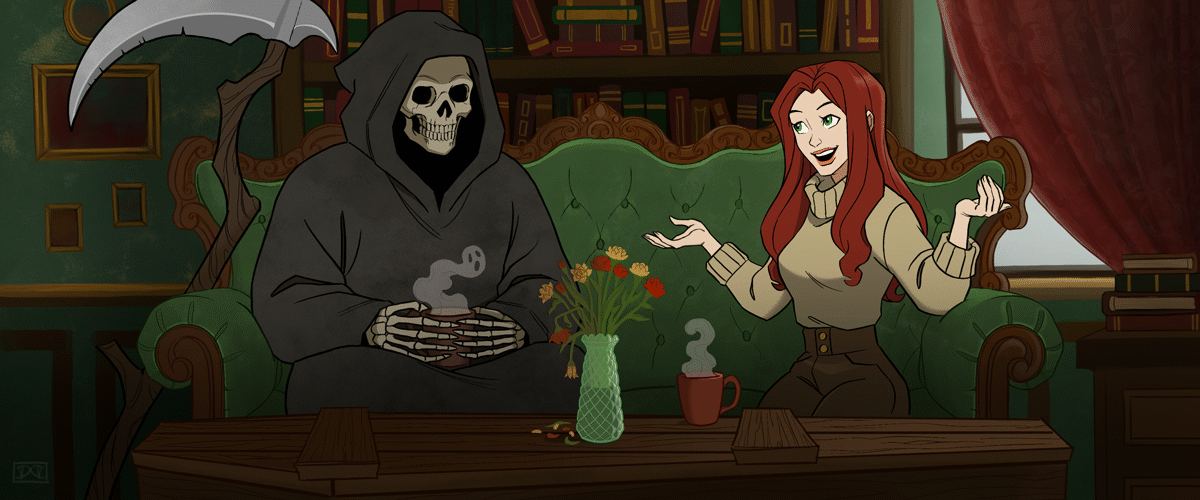
In Coffinfolk Café’s stand alone short stories, you’ll meet two most unlikely friends:
Quinley – Coffinfolk’s café host. A young woman who loves life just as much as she loves exploring the cultural heritage of death and sharing advice, information, and insights that can help people – whether they are facing their own encounter with Death or living with grief.
Herrow – Death himself. He may look frightening in his black cloak, but beneath the bones is a kind soul who enjoys a cup of coffee and sharing experiences gathered from every corner of time.
You can find a longer introduction + a short story about their first meeting HERE
“Celebrate What Is, Remember What Was”
Narrated by Quinley
The small houses stood silent along the road in the evening darkness. I hummed loudly to myself, singing the bits of verses I had managed to pick up. My Gaelic pronunciation was surely dreadful, so it was just as well that only Herrow and I could hear me. I skipped along while the Grim Reaper trudged at his usual, leisurely pace beside me.
“Haha! Maybe you’d have liked to stay a little longer? Should we go back again?”
“No, I want to see more!” I looked up at Herrow with a wide grin. “It was so amazing to see Samhain for real, not just our modern interpretations of it. I mean, the costumes, the songs, the joy, the community… the food!” I closed my eyes and inhaled deeply, as if I could still smell the wonderful aromas of fresh vegetables and roasted meat. “The animal sacrifices were a little… hard to stomach…” I shrugged, “but we Swedes dabbled in that once upon a time too, so who am I to judge.”
In the windows of the houses, small lanterns were lit. Too small to be pumpkins, but several of them had similar, creepy faces carved into them. The flickering flame inside made the eyes and mouth look even more menacing. The feeling that the lanterns were watching us out here in the dark gave me a shiver.
“Don’t worry,” Herrow rested his bony hand on my shoulder. “They’re meant to ward off evil spirits. We’re just curious spectators visiting from another time.”
"Where... When are we?"
“Let’s see. Scotland. The 1600s.”
I nodded as if the answer didn’t make my head spin. Time travel is amazing, but getting your mind to keep up is a different matter entirely.
Further ahead came a low laugh. A faint glow lit up the cobblestones.
I pressed myself closer to Herrow.
“Is that… Stingy Jack?” I whispered, clutching tightly at his cloak.
“Do you want to find out? It might just be a harmless nightwatchman.”
“No!” I hissed back. “Take us somewhere with more people. Please?”
The Reaper wove his thin fingers together with mine, and with a gust of wind we left the desolate streets behind.
Now came shouting and laughter. I cracked one eye open. People. Lots of people. The smell of alcohol stung my nose.
I let go of my death-grip on Herrow and looked around. Another city. Another time.
“Welcome to Boston, U.S., 1800s.”
“Ahh!” By reflex I ducked as a glass bottle came flying and shattered against the wall behind us. “What kind of drunken brawl is this?!”
“Looks like someone didn’t have treats to offer,” Herrow chuckled, pointing with his scythe toward a door now being bombarded with raw eggs.
“Good grief. Maybe it really was for the best that this turned into an activity for children after all…” I muttered, glaring at the crowd moving noisily on.
We went the other way and soon met more groups out trick-or-treating. This one had children with them. A father carried his little daughter on his hip. Her drowsy eyes flew wide when she pointed at Herrow. “Death!”
I stopped so abruptly that Herrow nearly bumped into me.
The father looked our way and stroked her hair. “He’s not dangerous, sweetheart. He’s the one who came to take Grandma when she went to Heaven, remember?” The girl nodded, popped her thumb into her mouth, and her eyelids drooped shut again.
I tugged at Herrow’s sleeve. “Can she see you?”
Herrow laughed, gently tilted my chin, and turned my head across the street. “Aha…” I was almost disappointed to see only a man in a long dark cloak with his hood up, leaning on a cane. “Ah well, close enough.”
Our travels and wandering were beginning to weigh on my feet.
Herrow wanted to show me one last thing before we returned to the café.
The first thing I noticed was the stillness. We stood outside a church. A familiar church. The cemetery glowed with what must have been hundreds of candles. By one gravestone sat a girl equally familiar.
“That’s… me…” It was such a surreal feeling, seeing myself from the outside like this.
Herrow stayed close as we approached. His hand squeezed my shoulder. Without making a sound we passed by other visitors who stood in silence or spoke in hushed tones beside the gravestones.
My cheeks burned as we listened to me talking to Grandma. It sounded like any ordinary conversation, and I half-expected to hear her answer back.
After a while I stood, brushing off the dirt from my pants.
“Enjoy the peace, Grandma. I’m off to meet the girls and watch some horror movies. If you get restless here, you’re always welcome to drop by. Happy Halloween!”
We stayed, watching me until I disappeared into the dark.
“This used to be one of the few days of the year when I didn’t feel strange for talking to the dead. A brief time when it actually felt allowed to talk about death.” I squeezed Herrow’s hand. “I’m so grateful I got to meet you, Harley, and all the guests at Coffinfolk. The decorations come and go, but the Halloween spirit remains. Speaking of which — shall we head back to the café?”
“If that’s what you wish,” Herrow said, leaning against his scythe.
In a heartbeat, we were back in the café. I blinked against the afternoon sun streaming in through the curtains. The smell of freshly baked apple pie made my stomach growl.
Harley, my boss and owner of Coffinfolk, stood just where we had left him. What felt like hours of absence to me had been but a second to him.
“Well? How was it?” Harley gave me a crooked smile as he straightened a blanket on one of the sofas. I staggered to another couch and plopped down heavily.
“It was… overwhelming. Fascinating. Magical!"
As if reading my thoughts, Harley brought over a sandwich on a plate and a steaming mug of hot chocolate.
“It’s no Celtic harvest feast, but at least it fills the belly.”
I mumbled a ‘Thanks!’ between bites and looked around the café, now dressed in its autumn decor.
That Harley loves Halloween is no secret, so I was eager to see how Coffinfolk would be decorated for the season—and I wasn’t disappointed!
The sofas and armchairs were draped with blankets in autumn colors. Tables were set with warm-toned cloths, candles, and small pumpkins we got from a local farmer. She said they weren’t pretty enough to sell, but we loved them despite their little flaws. The windowsills were now filled with guests’ creations: crocheted figures, painted candles, carved turnips, and pumpkins of different sizes, shapes and colors.
On one table in the middle of the room stood a sign reading: “Reserved – for those who live on in our memories.”
One of our guests had baked funeral confections—yes, meant to be eaten—as a sweet, slightly macabre joke. They were gone in a day, and people asked for more.
This truly was a place where everyone could feel welcome, however they celebrated—or if they didn’t celebrate at all. Even for those just dropping by from the other side of the grave. Our door is open to all.