
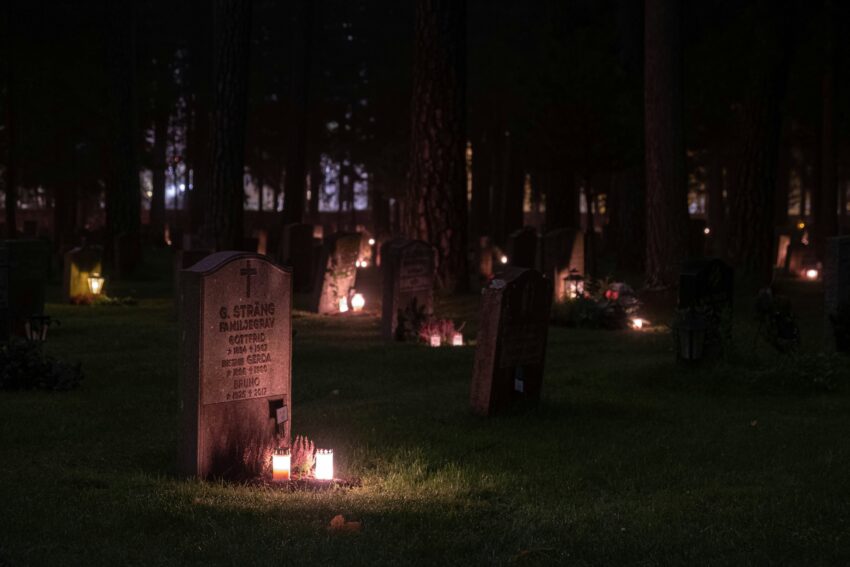
In today’s modern society, where most things have a logical explanation, cemeteries still carry an almost magical, faintly supernatural aura.
Perhaps there are things you do — or don’t do — purely on instinct, as if they are something we inherited and never needed to be taught were right or wrong.
When I visited “my” cemetery the other day, I found myself thinking about the unwritten rules most of us dutifully follow in such a place, even though we know there would likely be no real consequences if we broke them.
…but why take the risk and possibly offend someone who may have all the time in the world?
A Place Where the Boundary Between Worlds Is Thin
In many European countries, the cemetery is seen as a place where the boundary between the world of the living and the dead is very thin. Under the right circumstances, the dead could return to the dimension of the living.
During church holidays such as All Saints’ weekend, or around midnight, it was especially important to be cautious when visiting the cemetery. Otherwise, one might disturb the dead or attract the attention of a restless spirit. The spirit could then follow you home and haunt you.
If you called out the name of someone deceased, you risked receiving an answer.
…and they were not always willing to say “goodbye” again.
Whistling is also discouraged. It may be seen as a way of calling upon evil spirits, disturbing the peace of the dead, and is considered disrespectful in many cultures. Safer to listen to birdsong — or your own music through headphones instead.
Watch Where You Step
Many cultures consider it disrespectful to walk across a grave, as it disturbs the one resting there.
It may also bring bad luck, misfortune, or in some cases hasten your own — or someone else’s — death.
To stumble at a grave is considered a bad omen.
Walk carefully, for your own sake as well as for the dead.
The cemetery is meant to be a peaceful place, so do not rush. Move at the pace your body needs.
Gifts and Mementos to the Cemetery — Not From It
Many of us have left flowers or lit candles at a grave. In other cultures, offerings may also include coins, food, or drink.
Taking something home from a cemetery, however, rarely happens.
Whether it is soil, stones, decorations, or offerings, removing something from a grave — or worse, stealing from someone’s resting place — feels wrong.
It has long been seen not only as disrespectful but also as an act that brings misfortune upon the one who takes it.
If the feeling is particularly strong for you — that you do not want to bring home objects that once decorated a grave — consider using items made from natural materials that can decompose, if you wish to bury them respectfully after they have fulfilled their purpose by the gravestone.
Guardians and Protectors
There has been much talk of bad luck and misfortune — but there are also benevolent forces said to keep evil at bay. Church bells, for instance, whose ringing once called the congregation to service and drove away malevolent spirits.
Yew trees remain green all year round and are not only symbols of the soul’s immortality; these resilient, long-lived trees are also said to offer protection against dark forces.
The Church Grim is another guardian who may still roam the cemetery grounds. It is often described as a large black dog with red eyes. Some stories speak of a fearsome beast one would do well not to provoke.
You can read more about the Kyrkogrimm HERE.
Signs That Comfort in Grief
Seeing animals such as butterflies or birds land on a gravestone — or on your own hand — can create a sense of presence from the one you miss. Likewise, when a candle flame flickers though the air is still, when it suddenly goes out, or when it burns unusually long, it may be interpreted as a sign from the other side.
Try not to search actively for these signs — the heart will tell you when they happen.
I am not religious, but it often feels as though something — or someone — is watching over me when I walk through a cemetery.
A safe, caring presence of some kind. Mutual respect.
Whether it is people on the other side, the yew trees, or the Kyrkogrimm, I leave unsaid.
Perhaps many of the superstitions surrounding the cemetery are simply reminders to show reverence for those who have rested there longer than we have lived.
Are you superstitious when you visit a cemetery?
A short story with Quinley & Herrow

Who are Quinley and Herrow?
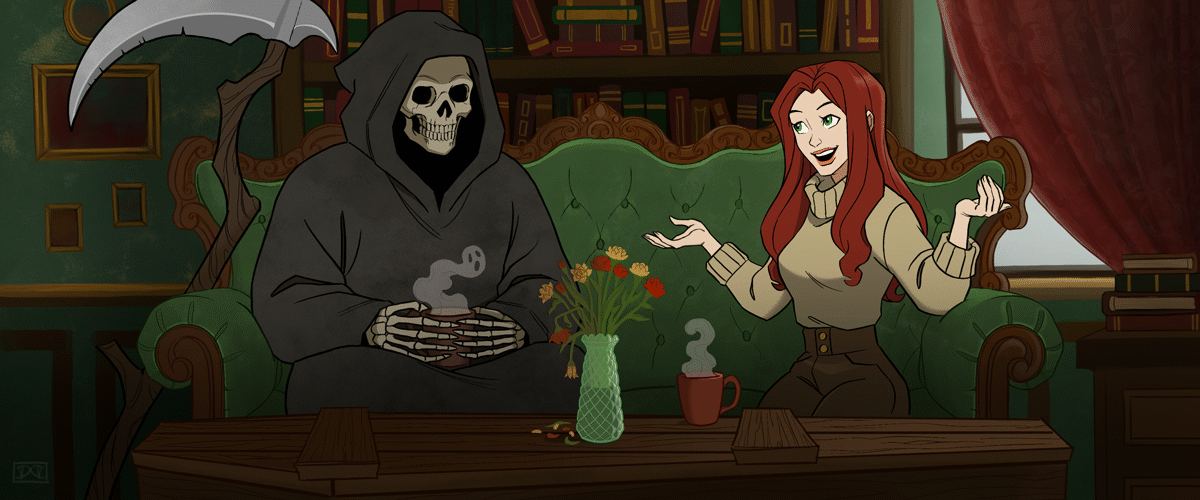
In Coffinfolk Café’s stand alone short stories, you’ll meet two most unlikely friends:
Quinley – Coffinfolk’s café host. A young woman who loves life just as much as she loves exploring the cultural heritage of death and sharing advice, information, and insights that can help people – whether they are facing their own encounter with Death or living with grief.
Herrow – Death himself. He may look frightening in his black cloak, but beneath the bones is a kind soul who enjoys a cup of coffee and sharing experiences gathered from every corner of time.
You can find a longer introduction + a short story about their first meeting HERE
“The Guardian of the Cemetery”
Narrated by Quinley
The cemetery looked so different in daylight compared to last night.
I had never been one of those people who find this place frightening, whether in sunlight or moonlight—it simply has a different “feel.”
During the day it was like a quiet oasis away from the city’s traffic and crowds.
At night it was… my savior.
The hair on the back of my neck rose when I thought about what happened—and what could have happened—if the tall iron gates had been locked.
“Whoever chose your headstone—” I squinted to make out the weathered inscription, “Henrik, I want to say thank you.” The bouquet of pink tulips looked almost out of place against the moss-covered stone, which had likely stood there long before my grandmother was born. The year was too worn to read properly.
“Are you so fond of men in uniform that you even court those long deceased?”
The hoarse voice laughing beside me could only belong to one person—or one being. I looked up at Herrow as he appeared at my side.
“Uniform?” I glanced at the headstone. “Was Henrik in the military?”
“Police officer. Died in the line of duty.” Herrow’s answer felt like a cool hand squeezing my heart.
“Oh. He continues to protect people, even in death.”
Herrow’s vertebrae clicked as he turned toward me so quickly I barely registered the movement.
“What happened?”
“I was on my way home from the cinema. Someone started following me and I couldn’t shake him. I took a detour past the cemetery, slipped in through the gate and hid here behind the stone. Thankfully, he didn’t follow me inside.”
“Well done. Even those who are unfortunate in thought seem capable of respecting a cemetery’s peace.” He extended a bony hand and helped me to my feet. I took a misstep and stepped across the grave.
“Oh—sorry!” Herrow’s gaze flickered between the well-kept lawn and me.
“I don’t think he minds.”
“It still feels wrong.” I shrugged and walked as if along an invisible tightrope between Henrik’s grave and his neighbor’s until I reached the gravel path.
We walked slowly along the stone wall enclosing the cemetery. A cool breeze carried the fresh scent of yew—and Herrow’s own scent of juniper and lilac.
“Herrow… Is there something here that guards or protects this place? I mean something like you—something more than what people simply call a ‘presence’?”
“Does it feel like someone is keeping a watchful eye on you here?” I nodded slowly.
“I never feel alone here, even when no other people are nearby. But it’s always a safe feeling. Never suspicious. Never threatening.”
“You move with respect and act with reverence. That does not go unnoticed.”
“In that case, Mr. Lind must have taken real offense when I accidentally tripped over his grave. After that I felt cursed with bad luck for three days…” I muttered, glancing toward the headstone whose lower edge was nearly hidden in the grass—practically designed to trip people.
“Oh, that was likely just an unfortunate coincidence. But to be safe, perhaps take a detour if you need to pass Mr. Lind again. If nothing else, for your own sake—so you don’t hurt yourself.”
Farther away, I noticed a woman moving from one grave to another. When she picked up a lantern and carried it toward the first grave, I was torn between rushing over to scold her and remembering the unspoken rule to preserve the place’s stillness.
I glared at her, frozen where I stood. She must have felt watched, because she looked up.
When she saw me, she quickly turned on her heel and hurried toward one of the exits with long strides.
I hurried to the grave that had been decorated with stolen goods and picked up the lantern.
“It’s nothing personal. It simply wasn’t left for you.”
I marched over and returned it to where it belonged.
“There. Order restored.”
A loud crash sounded outside the cemetery gates. I stood on my toes to see what had happened, and it was hard not to smile with a flicker of schadenfreude when I saw the woman sprawled beside her bicycle. She was quickly back on her feet and climbed onto it again.
“Haha, perhaps it isn’t always just unfortunate coincidences after all.” Herrow turned to me.
“Respect is a curious force. It protects those who show it—and reminds those who forget.”