
A child’s curiosity and sense of discovery is something almost magical. They have an entire world to explore and so many questions swirling around in their little heads.
Sometimes those questions make adults squirm, scrambling to come up with an appropriate answer that satisfies the curiosity and puts an end to further follow-up questions.
Questions about death, for example.
I believe the opposite approach is better: we should encourage children’s thirst for knowledge, even when it comes to difficult topics like what happens at the end of life. Most things can be described and explained in a way that isn’t too frightening or macabre.
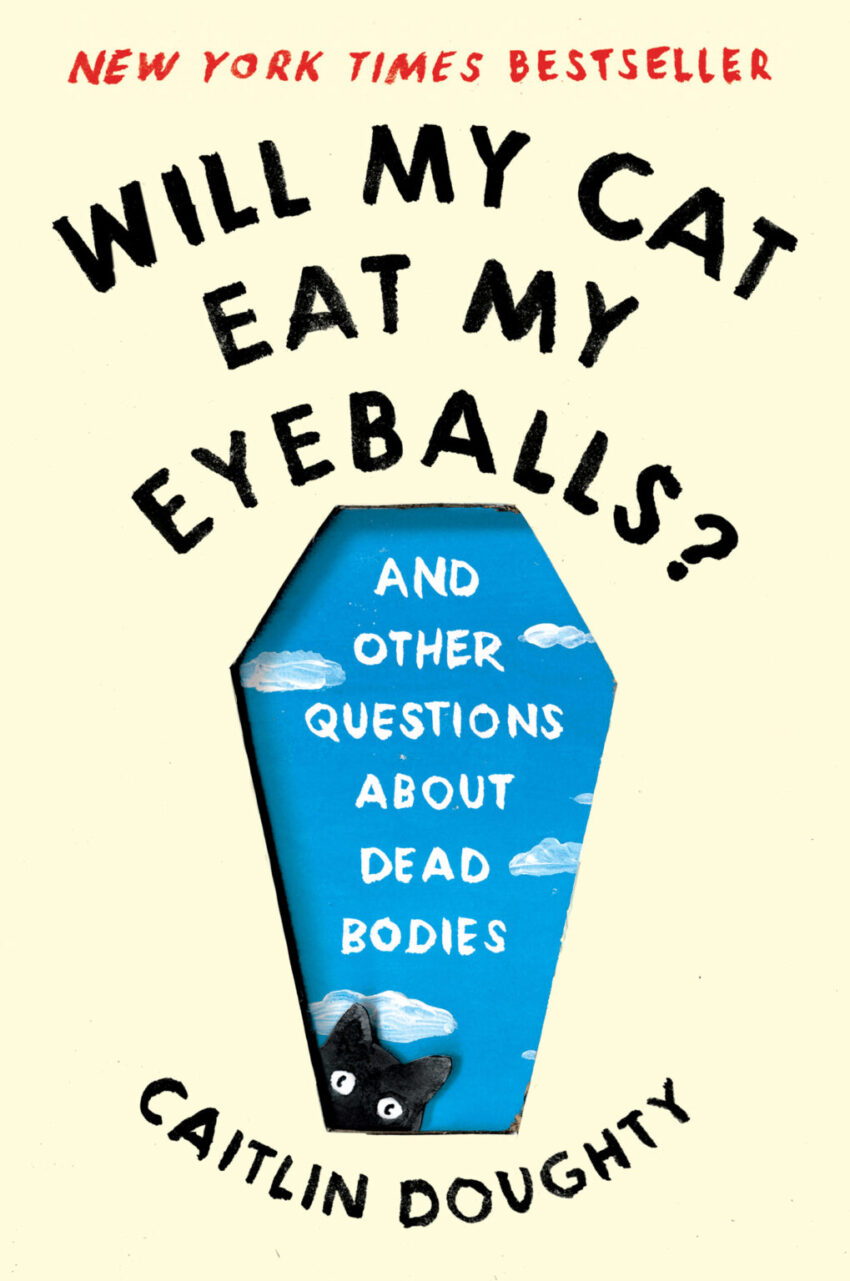
Children often ask the best questions—sometimes about things I’ve never even considered myself, but suddenly I want to know the answer too once the question has been asked. That’s why I highly recommend Caitlin Doughty’s book “Will My Cat Eat My Eyeballs?: Big Questions from Tiny Mortals about Death”, in which she uses her expertise, warmth, and humor to answer thirty-five questions from curious little kiddos.
Book blurb:
Every day, funeral director Caitlin Doughty receives dozens of questions about death. The best questions come from kids. What would happen to an astronaut's body if it were pushed out of a space shuttle? Do people poop when they die? Can Grandma have a Viking funeral?
I Will My Cat Eat My Eyeballs? , Doughty blends her mortician's knowledge of the body and the intriguing history behind common misconceptions about corpses to offer factual, hilarious, and candid answers to thirty-five distinctive questions posed by her youngest fans. In her inimitable voice, Doughty details lore and science of what happens to, and inside, our bodies after we die. Why do corpses groan? What causes bodies to turn colors during decomposition? And why do hair and nails appear longer after death?
Readers will learn the best soil for mummifying your body, whether you can preserve your best friend's skull as a keepsake, and what happens when you die on a plane.
Beautifully illustrated by Diann Ruz, Will My Cat Eat My Eyeballs? shows us that death is science and art, and only by asking questions can we begin to embrace it.
The book is available in hardcover and as an audiobook narrated by Caitlin Doughty.
It is only available in English.
What is the most memorable question about death you’ve ever heard from a child?
A short story with Quinley & Herrow

Who are Quinley and Herrow?
In Coffinfolk Café’s stand alone short stories, you’ll meet two most unlikely friends:
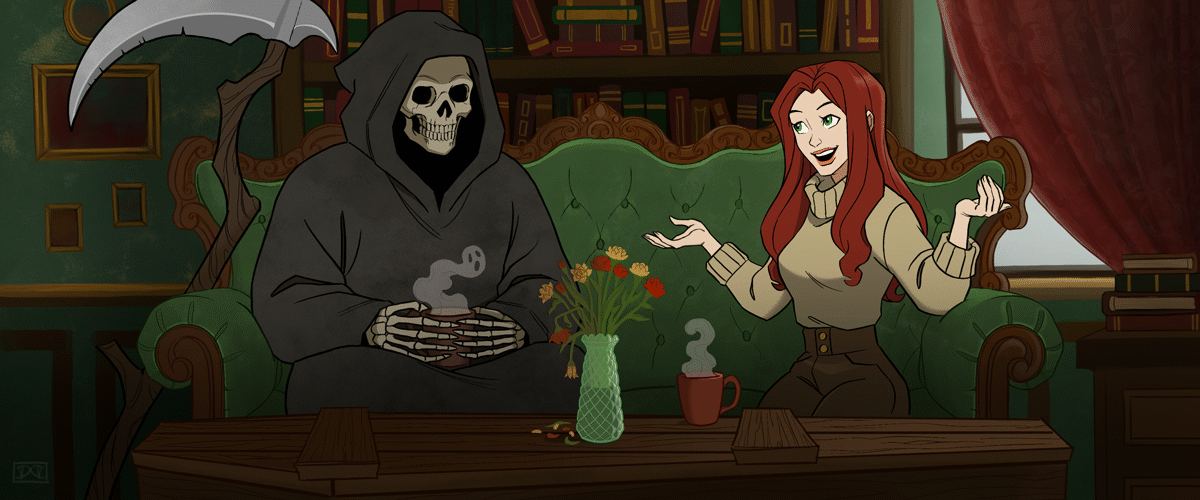
Quinley – Coffinfolk’s café host. A young woman who loves life just as much as she loves exploring the cultural heritage of death and sharing advice, information, and insights that can help people – whether they are facing their own encounter with Death or living with grief.
Herrow – Death himself. He may look frightening in his black cloak, but beneath the bones is a kind soul who enjoys a cup of coffee and sharing experiences gathered from every corner of time.
You can find a longer introduction + a short story about their first meeting HERE
“Curious Seeds Ask, and the Reaper Answers”
Narrated by Quinley
Coffinfolk has no age limit, and it’s always a joy when we get visits from little kids.
Just like with adults, some of them are bold and curious while others are quiet and reserved.
Last week, a father brought his daughter for the first time. She looked around as if it were any ordinary café. The fact that a grim reaper was sitting on one of the sofas drinking coffee didn’t seem strange to her at all. The father bent down to explain who Herrow was, and that he was kind even if he looked a bit scary.
The little girl turned to her dad:
“Daddy, he’s just a skeleton. Those aren’t dangerous.”
I exchanged a glance with Harley behind the counter. My boss shrugged and gave a crooked smile.
“Well, she’s not wrong.”
I had to agree — Herrow had a wonderful way with both animals and people, especially children.
As expected, it only took a few minutes after they’d sat down before Herrow joined them, and the girl’s questions began to flow freely.
“Don’t your feet get cold when you walk in the snow without shoes?” “Do you ever sleep in, or do you work all the time?” “Do you collect animals and flowers when they die?”
The father followed the conversation, looking just as curious about the answers as his daughter.
The girl chewed her muffin slowly while she thought of more questions.
She reached for Herrow’s hand and placed her own, much smaller one, over it.
“Do you get sad when people are scared of you? And who comforts you when you’re scared?”
The father froze mid-sip, caught off guard by the depth of her thoughts. I felt the same sudden ache and warmth in my chest at once. Kids are wiser than we give them credit for.
“I don’t get sad for my own sake, but I can feel sad for theirs. I don’t mean anyone harm when I come to fetch someone. I just don’t want anyone to go alone, so I come to keep them company on the journey to Eternity.” Herrow took a sip of coffee before continuing:
“I’m rarely afraid, but sometimes I get nervous when Harley wants me to try one of his new coffee drink recipes.” Herrow leaned closer to the girl as if they were sharing a secret.
“I heard that!” Harley snapped, laughing.
“Good!” Herrow replied with a chuckle.
Another memorable day was when I came into the café and found Herrow’s cloak spread out across the floor. On top of the black fabric lay Herrow — or at least parts of him. The rest lay in a little pile beside him. A woman was gently picking up one bone at a time and handing it to a boy and a girl, who examined each piece and named it before pointing out where it should go.
Harley sat on a sofa watching them work.
“We’re having an anatomy lesson. Annika here is an orthopedic surgeon and front-runner for ‘Aunt of the Year.’”
Annika looked up with a smile as she handed what even I could recognize as one of Herrow’s femurs to the kids.
“My sister hopes the kids will follow in her footsteps and become accountants, but now that they’re studying anatomy in school, they seem to take after me instead.”
“I hate math…” the girl muttered, pointing to where the bone should go. “I want to be an archaeologist. History is way more fun.”
“I think I want to be a pathologist. It sounds cool, and I like solving mysteries,” the boy chimed in.
Annika rolled her eyes and sighed.
“I told Jimmy not to show you the morgue… That’s the last time I leave you with him when you visit me at the hospital.”
The kids immediately began to object in protest.
“I’m guessing you were curious as a kid too? And you turned out fine anyway,” I teased, taking the children’s side.
“Yeah, yeah, that’s true…” Annika picked up one of the smaller bones.
Neither of the kids knew the answer. I had no idea either.
One of Herrow’s hands slid across the cloak and tapped the girl’s knee. When she looked down, the hand pointed to where the other hand should attach to the lower arm.
“Oh! It’s, um, the wrist-something bone.”
“No cheating, Herrow!” Annika scolded.
Herrow’s skull turned, and I knew he was smiling even if he couldn’t show it.
“Oh, come now. I’m here to answer questions, after all.” His spine curled together with a soft clicking sound. “If some kind soul could scratch me on… what was it again? Vertebrae T1 to T3, I’d be eternally grateful.”
There’s something special about seeing children interact with Death with curiosity instead of fear and prejudice. I wish more adults could see Death the way a child does, and dare to ask questions without filtering them through “What will people think?” first.There are no stupid questions.