

Grief wears many colors. Here in Sweden, black is probably the first that comes to mind – but around the world there’s a whole palette of shades, each carrying its own meaning in the face of death. From white in Asia to purple in Brazil, every color tells a story about how people understand loss, remembrance, and hope.
⚫ Black
The most common mourning color in Sweden, the rest of Europe, and North America. We dress in black at funerals to symbolize our loss and longing. Black often represents formality, endings, absence, and, of course – the grieving process itself.
⚪ White
The traditional mourning color in many Asian cultures, such as China, Japan, Nepal, and India.
While in the West we often associate white with bridal gowns and weddings, here it stands for purity, spirituality, and rebirth. At funerals, mourners often wear white, decorate with white flowers, and so on.
🔴 Red
In South Africa, red is worn in mourning and at funerals. Like in many cultures, it represents passion and love, but here it also carries a heavier association with blood and sacrifice.
In China, however, red symbolizes prosperity and joy – which is why it is carefully avoided at funerals.
🟠 Orange
In Hinduism, orange symbolizes fire – and fire’s power to cleanse. It also represents holiness, transition, and spirituality, which makes orange a fitting color for cremation rituals.
Orange is also tied to autumn – harvest, rest, and endings. The expression “in the autumn of one’s life” reflects how old age mirrors autumn: the closing of one life cycle, just as autumn ends the cycle of seasons.
🟡 Yellow
In some Latin American cultures, yellow stands for both death and the transition to new life.
In Mexico, golden marigolds are used during Día de Muertos (the Day of the Dead) to decorate ofrendas (altars for the dead). Their bright petals are said to help guide the souls of the departed back to their families.
🟢 Green
In the Middle East and parts of Islamic culture, green symbolizes life, eternity, and paradise.
In 19th-century Europe, green wallpaper was all the rage – but the bright pigment often contained arsenic. People grew ill, and in some cases even died of poisoning, earning green the eerie nickname “the color of death.”
🔵 Blue
In ancient Rome, blue was associated with grief and barbarity (Celts and Germanic tribes used blue face paint in battle).
In parts of the Middle East, blue can be a mourning color as well, but it also symbolizes peace and deep respect for the dead.
The English expression 'feeling blue' goes back to the 1600s, when people spoke of “blue devils” causing melancholy.
🟣 Purple
In the Catholic Church, purple (or violet) is a significant liturgical color symbolizing reflection, penance, and preparation. It is used during Lent and Advent, seasons of repentance and renewal. Purple also represents Christ’s suffering and resurrection.
In ancient Rome, mourners wore purple to symbolize life fading and the transition into death.
In Greece and Brazil, purple is a mourning color, and in Thailand, widows traditionally wear purple during their mourning period.
Whatever the shade, colors have always helped people, across times and cultures, to give form – and color! – to what is otherwise so difficult to put into words.
Which color do you associate with mourning – and if you could choose, what color would you want your guests to wear at your own memorial?
A short story with Quinley & Herrow

Who are Quinley and Herrow?
In Coffinfolk Café’s stand alone short stories, you’ll meet two most unlikely friends:
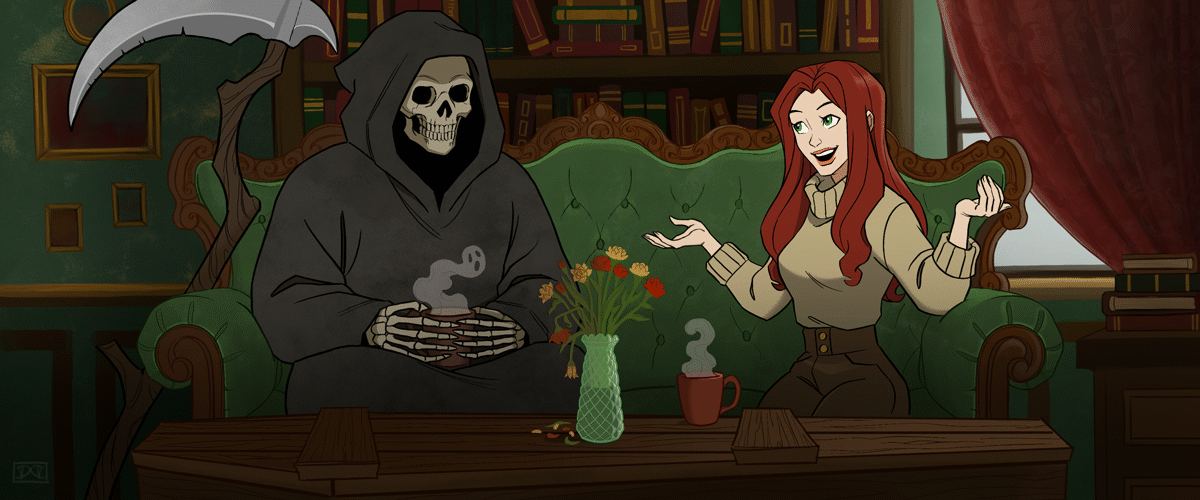
Quinley – Coffinfolk’s café host. A young woman who loves life just as much as she loves exploring the cultural heritage of death and sharing advice, information, and insights that can help people – whether they are facing their own encounter with Death or living with grief.
Herrow – Death himself. He may look frightening in his black cloak, but beneath the bones is a kind soul who enjoys a cup of coffee and sharing experiences gathered from every corner of time.
You can find a longer introduction + a short story about their first meeting HERE
“Curtains of Comfort”
Narrated by Quinley
How can such a simple task be so hard? Pick one! Or two…or three…
“Ugh!” I leaned back on the couch and glared at the pile of fabric stacked on the coffin we used as a coffee table.
Coffinfolk was getting new curtains, and it was my task to pick the fabric. Simple, right?
A glance at the clock betrayed just how long this indecision had dragged on.
The now well-worn paper where Harley, the café’s owner, and I had listed different mourning colors from cultures and religions around the world wasn’t much help after all. Most of our visitors are Swedish, but we also get people from further afield, and it’s important that everyone feels welcome here.
I plucked at a beautiful purple fabric. But green would look nice too. Or red. Or—
“Herrow, help!” I barely had to call before his familiar voice answered.
“What is this lament I hear?” chuckled the Reaper, now seated on the couch across from me.
“Decision fatigue. Color. Curtains,” I groaned.
Herrow glanced around the café, its walls painted and papered in soft tones, the mishmash of sofas and armchairs giving the space its cozy, homey charm. He looked at me with his empty eye sockets.
“Oh, my dear Quinley. Harley knew exactly what he was doing when he gave this task to you.”
I shot Herrow a long look.
“Not if he wants new curtains before the end of the decade…”
The Reaper leaned forward and dragged the paper toward him with a bony finger.
“Grief doesn’t have just one color. Even for the same person, it can change over time.”
“I know—that’s what makes it so hard,” I muttered back. “I know I can’t please everyone, but I at least want to disappoint as few as possible…” I pursed my lips, drumming my fingers on the coffin lid. Then it hit me. “I’ve got it! If grief has many colors—why not let our curtains show them all?”
I leapt off the couch and dashed into the storage room, where you could always find whatever you needed. I kicked the door shut behind me with an old sewing machine and a box of supplies in my arms.
“Put the coffee on, Herrow—we’re having a sewing circle!” I giggled.
I could have sworn he smiled to himself as he shuffled behind the counter to start the coffee maker.
The next morning I could barely sit still, waiting for Harley to walk through the door and see our masterpiece. When the little bell over the entrance finally jingled, I jumped up from my stool behind the counter and hurried over. Harley stood there, staring at the new curtains.
“Well? What do you think?” I bit my lip, rocking on my feet.
“It’s… It’s colorful, to say the least,” Harley said with a crooked smile.
“Exactly! Grief isn’t just one color—it’s a patchwork of shades. Now everyone can see their own color, for themselves, for today, when they come in here.” I quickly added, “…if you hate it, Herrow suggested beige…”
“Bone white!” Herrow corrected from his usual spot on the sofa, where he sat with the morning paper and a cup of black coffee.
“No, it’s perfect,” Harley laughed, patting my shoulder. “I knew you were the right person for this. Grief can make you fall to pieces, so it’s good to be reminded that, with time, you can stitch yourself back together, one patch at the time. There’s room for grief in all its forms, in all its colors, here at Coffinfolk.”