
I rarely read poetry, but sometimes you stumble upon a piece that carves out its own place in your heart. Andrea Gibson’s poem When Death Came To Visit is one of those.
This was my first encounter with Andrea Gibson’s writing, and it was with a heavy heart that I read they had been diagnosed with incurable cancer and passed away in the summer of 2025.
Andrea’s surviving partner, Megan Falley, wrote more about the circumstances surrounding the creation of the poem, and when the time came to share it with the world. You can read that text HERE.
In this video, Andrea reads parts of the poem themselves. You’ll find the full version further down this page. Listen, read along with Andrea, or read it quietly to yourself.
Let the words sink in and sit with them for a while, even if it feels a little unsettling at first.
When Death Came To Visit
When death first came to visit, I refused
to let her enter my home. She sat outside
in the garden picking buttercups, painting
her face the color of the sun.
I stood at the window for hours
watching her, thinking, Why is she still here?
It’s not like she has nowhere to go. I’d try to sleep,
but as soon as I closed my eyes
I would hear her outside talking
daisies into blooming at night.
I suspect she knew, I too am the type
to open my petals for the moon.
On my eighth night awake, I did it.
I don’t know how, but I did it––I walked out
to the garden and invited her in. I poured her
a cup of lavender tea. I made up her bed
and turned down the lights. I wished her good
dreams, though I knew her good dream
was to one day take my life.
I used to believe I knew my purpose,
thought for sure I understood my calling.
But my calling, I now know, has always been
this: to parent my own departure.
To never punish the child for being who she is.
To keep a roof over the head of the truth.
To raise what will end me, with love.
Now people often ask how it feels
raising a delinquent, a child capable
of such awful behavior.
But what rule has she ever broken
besides the ones we make up in our minds?
Ask me instead how it feels to raise a genius,
a child with a boundless IQ.
She could get away with anything, yes.
She could get away with me any minute.
But I trust her. I have to.
I see some of the letters on a chart on a wall.
She has infinity/infinity vision.
Besides, who would I be if I were someone
who would say, I’m gonna ground you
for wanting to heaven me?
I won’t do that, ever. It doesn’t matter
if I made her with my body or not. She’s mine.
I owe her a stable home. I owe her an allowance
without the stipulation
that she use it to buy me more time.
At night when I tuck her in, I read her a story
with the same three words on every page:
You are innocent. You are innocent. You are innocent,
I say. Before I close the book she asks,
But have you ever known anyone who is so unwanted?
It’s the saddest question in the universe,
and she asks it everytime.
“People don’t know you,” I say. “They’ll want you
when they meet you, won’t they?” She says yes,
looking me dead in the eye.
And you, she adds. You’re really okay
with who I want to be when I grow up?
I know I have to answer honestly.
I say, “I don’t want you to grow up too fast.
You know that. You know I can’t help
but be one of those parents who wishes their child
could stay a child forever. It’s only because I’ve cherished
these years so much. But when you’re ready,
I’ll be ready, I promise. I’ve committed
the rest of my days to learning how
to give you my blessing when it’s time
for you to follow your dreams.
I know it’s how you say, I love you.
I know others will hear it as a curse
and try to rinse your mouth out with soap.
But I will hear your I love you.
I will hear it so clearly my last words will be
I love you too, as I watch you
make something of yourself,
as I open my petals for the moon.”
I recognize myself so much in how Andrea describes their own relationship with Death, even though my image of Death looks different.
My hope is that you will be moved, and that you might begin to see your own—and others’—mortality in a different way.
Would you like to continue exploring your own image of Death? Get to know it better HERE.
A short story with Quinley & Herrow

Who are Quinley and Herrow?
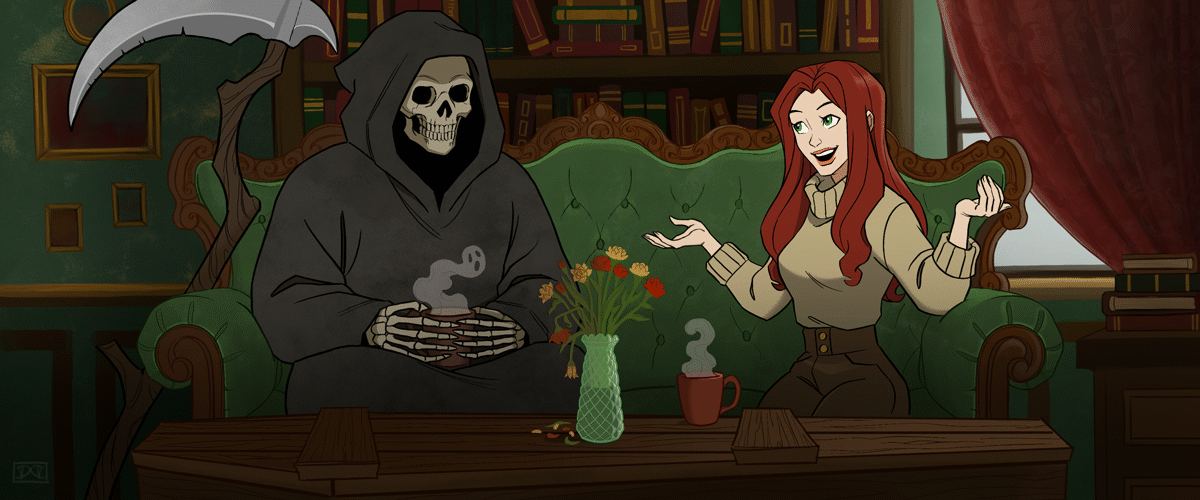
In Coffinfolk Café’s stand alone short stories, you’ll meet two most unlikely friends:
Quinley – Coffinfolk’s café host. A young woman who loves life just as much as she loves exploring the cultural heritage of death and sharing advice, information, and insights that can help people – whether they are facing their own encounter with Death or living with grief.
Herrow – Death himself. He may look frightening in his black cloak, but beneath the bones is a kind soul who enjoys a cup of coffee and sharing experiences gathered from every corner of time.
You can find a longer introduction + a short story about their first meeting HERE
“The Accused”
Narrated by Quinley
I had a feeling what was about to happen.
The grieving woman seemed almost surrounded by a visible darkness. Like a grey raincloud hanging over her head, ready at any moment to drench her in another downpour of rain and thunder.
She glared at Herrow. Her companion tried to draw her back into their conversation, placing a hand over hers. The tender gesture had almost the opposite effect. The woman pulled her hand away and pushed her chair back.
“Malin, wait. Come on, sit down again. Please?” Malin didn’t seem to hear.
When I had passed their table earlier, I’d caught that Malin’s husband had passed away after a period of illness. The man who had always been healthy, always active, always full of ideas and plans for the future. Now he was gone, and all the pain that followed was Death’s fault.
Herrow seemed to have something like a sixth sense for when people had something to say to him. He rose calmly from his place on the sofa as Malin came stomping toward him, her hands clenched at her sides.
“Oh no, not again,” I muttered quietly to myself, turning my back and pretending to fuss with the rows of tin canisters lining the shelves behind the counter. The thought crossed my mind to retreat into Harley’s office until it was over, but I didn’t want to leave Herrow—even if I knew he was more than capable of handling these kinds of encounters.
I almost expected my hair to start crackling in the charged air. Please, let it be quick. A sudden release, like a lightning strike.
Malin’s voice bounced off the walls as she let Herrow hear exactly what she thought of his existence, his purpose, and the fact that he had taken her husband from her.
Herrow replied in his usual calm, slightly raspy tone:
“What I do, I do with love.”
That, apparently, was the final straw. Her voice twisted into a wailing scream, followed by the sound of fabric tearing apart and ancient bones hitting the floor.
I squeezed my eyes shut when I heard the dry, brittle crack of bones breaking and being crushed to dust under her shoe.
It probably lasted only seconds, but it felt like hours—until everything fell silent, and the only sound left was Malin’s inconsolable sobbing.
Footsteps clattered against the worn wooden floor as her friend hurried forward.
I glanced over my shoulder and met the friend’s gaze.
“I’m so sorry. We— we’ll go now,” the other woman apologized, wrapping her arms around Malin as she guided them both toward the door. All I could do was nod.
As soon as they turned their backs, Herrow reappeared—just as calm and composed as ever, even though Malin had just tried to turn him into a heap of bone dust and torn cloth.
He raised a hand, and I wasn’t sure if it was to say goodbye for now, or if he had wanted to place it gently on Malin’s shoulder.
The door closed with a soft thud. I practically leapt over the counter to hurry to Herrow and wrap my arms around his thin form.
“I’m sorry I didn’t step in,” I murmured into the soft black fabric.
“It is not your task to try to control her outburst. If it hadn’t happened here, it would have happened somewhere else. At least here, she had a friend to lean on.”
I rested my forehead against Herrow’s collarbone.
“Grief can bring out the worst in people sometimes…”
“She is devastated. She is sad. She is disappointed. She is angry. Her husband did not choose to leave her, but your human emotions are not always the most logical—even when you know, deep down, what truly happened.” Herrow twirled a strand of my hair around a bony finger as he continued, “Right now, she cannot allow herself to admit that it is her husband she is truly angry with, so she directs that anger at me instead.”
I turned my head and looked at the paper still resting on the counter. A beautiful poem a guest had shown me earlier that day—When Death Came To Visit, written by Andrea Gibson.
I held Herrow tighter and quoted a few lines that had truly moved me:
“You are innocent. You are innocent. You are innocent.”
Herrow gave a soft chuckle and filled in Death’s voice from the poem:
“But have you ever met anyone so unwanted?”
Tears burned behind my eyelids as I continued:
“People don't know you.”
I felt sorrow for Malin’s pain. I felt sorrow for all the people who live half a life in their fear of death. Sorrow for Death, who exists as the eternally accused—when all he does is say I love you as he guides us toward whatever comes next.