

June is not only a month filled with rainbows. In the shadow of the colourful celebrations, another very important awareness campaign is taking place: Men's Mental Health Awareness Month..
June 13th is International Men's Mental Health Day.
I'd like to do my own small part, but not with dry facts, studies, and gloomy statistics.
Instead, this post is meant as a gentle encouragement and reminder that grief looks different for everyone.
Sometimes it comes with tears, sometimes it doesn't. Neither is right or wrong.
Grief Cannot Be Measured From the Outside
At a funeral, there is often someone who consciously or unconsciously takes note of how the other guests behave.
Who is crying? Who isn't? Who is grieving enough? Who is grieving "the right way"?
In my experience, there is often a little extra attention paid to how men express their emotions.
A man who cries openly is seen as weak or unmanly and should be strong and stoic.
A man who doesn't cry is seen as cold-hearted and should be more emotional, more visibly affected.
The truth is that grief can look very different, not only from person to person, but from one day to the next.
And whether or not someone sheds tears is a rather poor yardstick for measuring either their grief or their character.
You May Cry — But You Don't Have To
Washington Irving, the gentleman who wrote one of my favourite short stories, The Legend of Sleepy Hollow, also wrote this:
"There is a sacredness in tears. They are not the mark of weakness but of power.
They speak more eloquently than 10,000 tongues. They are messengers of overwhelming grief and unspeakable love."
I like that way of looking at tears.
Not because crying is the only way to grieve, but because it reminds us that tears are not a sign of weakness either.
If you cry when someone you love dies, that's okay.
If you don't cry, that's okay too.
Tears are not the measure of love, but if they come, let them come.
You do not need to explain them, defend them, or apologise for them.
As I mentioned in my previous post, I am transgender. Since starting testosterone hormone therapy, I do not cry as often during sad or difficult moments, but my feelings are no less genuine because of it.
Even when both words and tears are absent, the grief and longing remain.
They may simply be wearing a different suit than the one you're used to recognising.
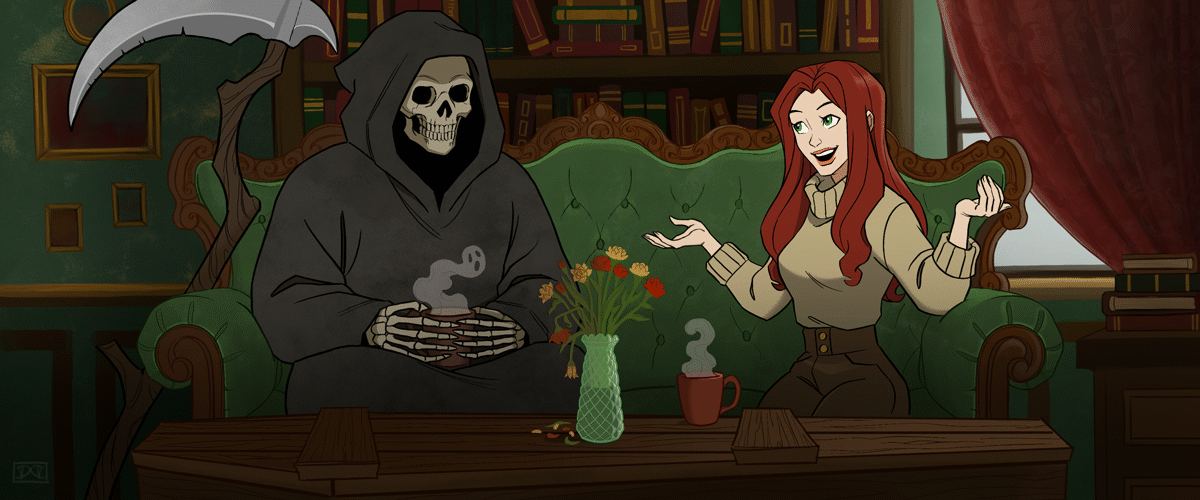
A short story with Quinley & Herrow

Who are Quinley and Herrow?
In Coffinfolk Café’s stand alone short stories, you’ll meet two most unlikely friends:
Quinley – Coffinfolk’s café host. A young woman who loves life just as much as she loves exploring the cultural heritage of death and sharing advice, information, and insights that can help people – whether they are facing their own encounter with Death or living with grief.
Herrow – Death himself. He may look frightening in his black cloak, but beneath the bones is a kind soul who enjoys a cup of coffee and sharing experiences gathered from every corner of time.
You can find a longer introduction + a short story about their first meeting HERE
“To Cry or Not to Cry — That Is the Question”
Narrated by Quinley
When the front door closed behind a cheerful group of customers, the café suddenly fell quiet.
I walked over to the only guest still sitting alone at his table.
“Would you like some more coffee?”
“Hm? Oh, uh, sure. Yes, please.”
Tobbe and I were about the same age, but he looked as though he'd aged at least ten years over the past few weeks. The grief after losing his uncle had probably hit harder than he'd expected.
I lingered for a few extra seconds to see if he wanted to talk about whatever was weighing on his mind. He slowly stirred his coffee in silence.
The moment I turned away, he looked up.
“The funeral is tomorrow. You've been to funerals before, right? I mean... you know how you're supposed to act?”
“I have.” I pulled out one of the empty chairs and sat down. “What is it you're wondering about?”
“It probably sounds stupid, but...” He ran a hand through his hair and shifted uncomfortably in his seat.
“There are no stupid questions. Right, guys?” I turned toward Harley and Herrow, who were sitting at another table gluing together a teapot that had taken a dive to the floor earlier.
“Ask away. If we don't know the answer, we'll find it,” Harley mumbled, focused on fitting the broken pieces together.
“Is it... Should I... Am I allowed to cry? Do I have to cry? Is it rude if I don't?”
My heart tightened. I'd always been quick to tears—whether I was sad, happy, or angry.
“Det är klart att– Jag menar, du får gråta. Men du måste inte.”
“But what do people expect?”
“Good question...” My dry response earned a chuckle from both Harley and Herrow. None of us were exactly what people expected.
“I didn't cry at my aunt's funeral, but it felt like my heart was”—Harley gestured toward the shattered pieces on the table—“smashed into fragments. If someone had commented on the fact that I wasn't crying, I probably would've told them to focus on why we were there. It wasn't to count how many tissues I needed.” Harley gave us a meaningful look.
In the blink of an eye, Herrow was suddenly sitting in the chair beside me, making Tobbe jump.
“Let the tears decide for themselves whether they want to fall or not,” Herrow said, patting Tobbe's arm. “You don't have to hold them back, and you don't have to force them out either.”
A loud clatter was followed by a string of muttered curses from the table beside us.
“I'd better give Harley a helping hand before he bursts into tears of frustration over here,” Herrow chuckled and returned to his seat.
“I can relate to Harley,” Tobbe whispered before taking a sip of coffee to hide his smile.
“Yeah,” I giggled. “Sometimes it feels good to cry a little, and sometimes you don't get much choice in the matter. But seriously, there's no shame in crying—or not crying—at a funeral or during your grief.” I glanced over at the teapot, which was slowly becoming whole again. “I hope tomorrow is a beautiful farewell for your uncle. The number of tears shed says nothing about how deeply he'll be missed.”