
What happens when we stop silencing the voice that whispers about death — and instead start talking about it openly?
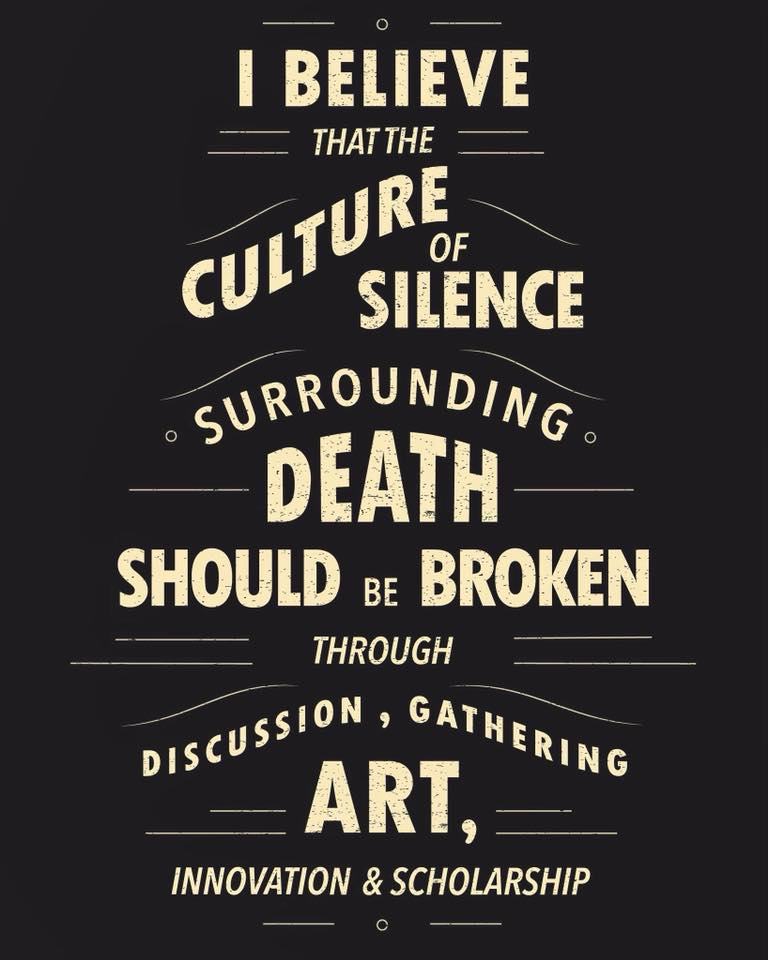
Being death positive isn’t about celebrating death, but about understanding it, giving it a natural place in our conversations, our culture, and our communities.
By talking about death with curiosity, honesty, and respect, we can reduce the stigma and fear surrounding it — and live a little more freely while we still can.
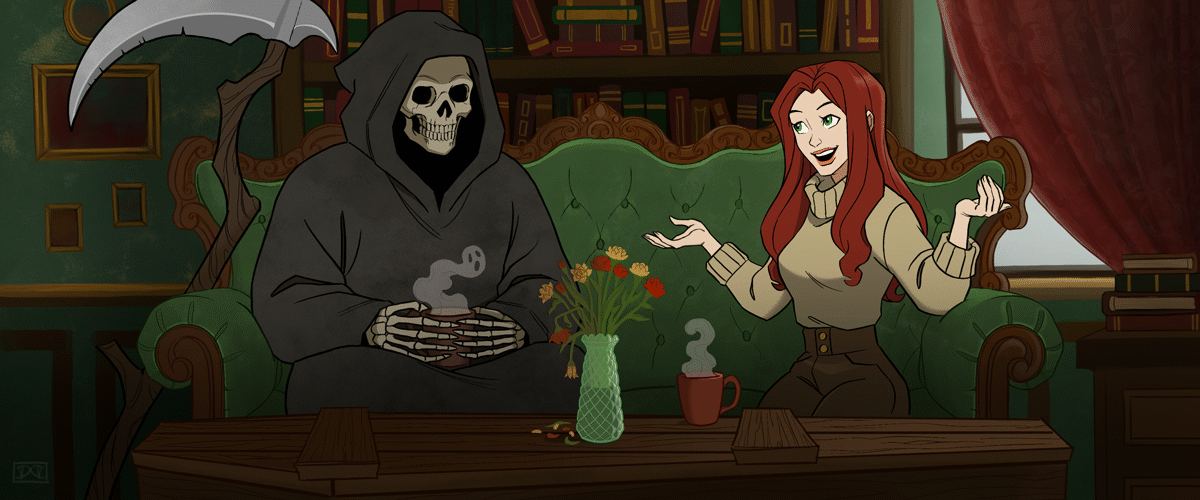
Image: Design by Erin Hancox (erinhanx)
More Than Just Accepting Death
Accepting death is often an internal decision — a recognition that death is a natural and inevitable part of life.
Death positivity takes it a step further.
To be death positive means to actively engage with the topic of death — to talk about it, explore it, understand it, and make space for it in everyday life.
It’s not about glorifying death, but about easing our fear of it — so we can live with greater awareness, openness, and compassion.
You could say acceptance is silent, while death positivity is conversation.
One says, “I know I will die.”
The other asks, “What does that mean for how I live today?”
What Death Positivity Is NOT
Death positivity is not about glorifying, romanticizing, or diminishing death – or grief.
Death positivity is not about glorifying, romanticizing, or diminishing death – or grief.
You can be death positive and still feel fear about your own mortality or that of someone you love. Finding support to face that fear – through conversation and education – is at the heart of the death positive movement – me included.
There is no right or wrong way to view death or what comes after.
Death positivity is more of a life philosophy than an opinion, independent of religion or politics.
Death positive people come in all forms and from all walks of life. We’re not a uniform group — what unites us is the desire to change how society, culture, and everyday conversation relate to death.
That’s what makes us death positive — not our style, music taste, or background.
Finding Lightness in the Heavy
Being death positive doesn’t mean taking death lightly. It’s about making space for both gravity and relief.
Talking about difficult things in an open, curious, and sometimes humorous way can make it easier for others to join the conversation.
Humor can be a bridge to comfort and connection — even in life’s darkest moments.
It takes sensitivity, of course, but sometimes laughter is exactly what helps us breathe again.
The Death Positive Movement
The Death Positive Movement began with American funeral director, author, and YouTuber Caitlin Doughty , along with the organization The Order of the Good Death.
The movement encourages open, honest discussions about death — at home, in culture, and in society. It aims to bring more transparency, choice, and understanding to everything surrounding the end of life, and to challenge the silence and avoidance that often surround death in Western culture.
Interest in the movement continues to grow worldwide — through conversations, blogs, podcasts, art, research, and funeral work — all sharing the same goal: to make death less frightening and more human.
I’ve been a member of The Order of the Good Death for several years and am a big fan of Caitlin Doughty.
Through Coffinfolk Café and the characters Quinley & Herrow, I hope to spark curiosity about death positivity — or at least make it a little easier to approach death-related topics and find comfort in grief.
Have you heard of death positivity and the Death Positive Movement before? Do you see yourself as death positive?
A short story with Quinley & Herrow

Who are Quinley and Herrow?
In Coffinfolk Café’s stand alone short stories, you’ll meet two most unlikely friends:
Quinley – Coffinfolk’s café host. A young woman who loves life just as much as she loves exploring the cultural heritage of death and sharing advice, information, and insights that can help people – whether they are facing their own encounter with Death or living with grief.
Herrow – Death himself. He may look frightening in his black cloak, but beneath the bones is a kind soul who enjoys a cup of coffee and sharing experiences gathered from every corner of time.
You can find a longer introduction + a short story about their first meeting HERE
“Life-changing Conversations About Death”
Narrated by Quinley
The little bell above the front door chimed — but no one came in.
It was the third time in the past ten minutes that someone had changed their mind on the threshold.
I looked questioningly at Harley, who answered with a shrug.
The stool scraped softly against the wooden floor as I got up from behind the counter.
“I think I’ll just go sweep the leaves outside,” I said.
Harley’s quiet chuckle hinted that my curiosity wasn’t nearly as subtle as I hoped.
Ah well — armed with a poor excuse and the broom standing by the door, I peeked out into the sleepy alley where our café was tucked away.
Just as I suspected, a lost soul stood there, fidgeting. I greeted her cheerfully while sweeping up the few autumn leaves that had drifted onto the cobblestones.
The woman cleared her throat and took a hesitant step closer.
“Excuse me… do you work here?”
"Yup!"
“Um, is it true that you—” She swallowed hard and leaned in, as if sharing a secret. “Is it true that you can talk about death here?”
“Absolutely! Here you can talk about Death — or with Death, if you’d like.”
Right on cue, Harley’s laughter rang from inside the café — no doubt Herrow telling one of his dreadful dad jokes. “…and it doesn’t always have to be grave business,” I added with a grin.
The woman’s eyes darted between me and the door.
“I’ve been trying to find other death positive people to meet outside the internet, but people just think I’m crazy. The moment they hear the term ‘death positive’, they assume I’m cheering for people to die — or that I’m obsessed with my own.”
I nodded as she spoke. I knew exactly what she meant. Before I met Herrow — and later found my place here at Coffinfolk with Harley — I’d been in the same situation.
“You can feel safe talking freely here,” I said. “People come to listen, to share, to ask questions — without judgment. And if you’d rather sit quietly with your thoughts, that’s perfectly fine too.”
The heavy wooden door creaked as I opened it, the little bell chiming once again as we stepped inside.
“Look what I found!” I called to Harley with a wide grin, setting the broom back in its corner.
“Welcome,” Harley said warmly, shaking her hand and asking what our new guest would like to drink.
“Coffee, please. Black.” Her voice was still barely above a whisper.
“A coffee drinker after my own heart,” rasped Herrow from his spot on the sofa. He raised his own cup of black coffee in a bony hand and nodded to the newcomer.
She gasped, her eyes following the Reaper’s every movement.
Harley approached with two cups in hand.
“Don’t worry,” he said with a wink. “He keeps his distance until you’re ready to say hello.
Unless, of course, you suddenly drop dead.” That bit of dark humor broke her trance — she even managed a nervous giggle.
Harley guided us to a table where Rosie, also known as ‘the Cheerful Widow’, was busy with a crossword. Rosie’s warm personality and contagious smile could make anyone relax. She looked up, removed her glasses, and smiled as Harley set down the cups.
“This is—?” Harley looked apologetically at the woman beside me.
“Mia,” she replied softly.
“Mia’s new here,” Harley began, but Rosie was already on her feet.
“Oh, how lovely — another new face! Come, sit, before your coffee gets cold.” Mia hung up her coat and settled in.
Harley and I exchanged a smile as he returned to the counter, and I took one of the empty chairs at the table.
“It must sound silly,” Mia said after a moment, staring into her cup, “that I came here to talk about death when I’m so afraid of it.” Rosie patted her hand.
“Nonsense! I couldn’t even be in the same room as him at first. Yesterday we sat at the same table, chatting with our dear Quinley here.” She gave me one of those smiles that could melt even the coldest heart.
“Being death positive doesn’t mean being fearless,” I said. “Especially not about something as vast and unknown as death. What matters is that you’re willing to face the fear.”
“I have to admit,” Rosie said, chuckling, “he can be quite funny sometimes.”
I thought of Herrow’s dreadful puns about himself and started laughing too.
As time passed, Mia changed before our eyes. She sat up straighter, her voice grew stronger. When she spoke excitedly, her hands joined in as much as her words — just like mine did. And her laughter — bright, clear, and ringing — sounded so much like Rosie’s. It seemed Mia had found her voice again.