
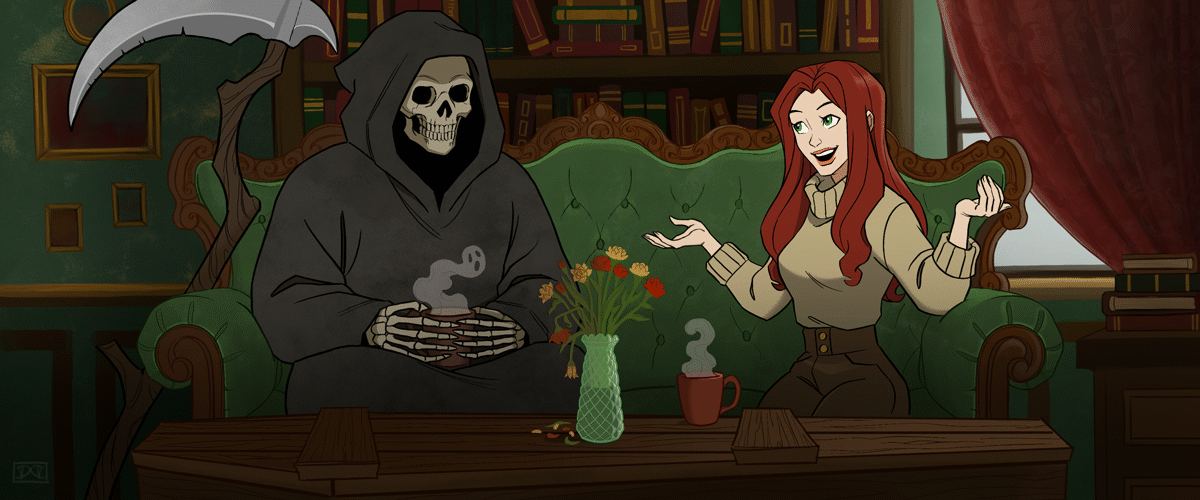

Death can feel heavy and frightening – but in Mexico it is met with color, music, and humor. Día de Muertos is a reminder that our loved ones never truly leave us, as long as we remember them.
Here you can read about the celebration of the “Day of the Dead,” which, despite its theme, is anything but gloomy.
A blend of the old and the new
The tradition of honoring the dead has its roots in pre-Columbian cultures, going back as far as 3,000 years. When Christianity came to Mexico, Catholic beliefs were woven together with the ancient ceremonies. The celebration was moved to coincide with the Christian holidays All Saints’ Day (November 1) and All Souls’ Day (November 2).

The mascot La Catrina
La Catrina, the skeleton dressed as an upper-class lady, was created as a satirical figure by Mexican artist José Guadalupe Posada in the early 1900s. Posada used her to criticize people who tried to imitate the European elite and were ashamed of their own roots.
Later, artist Diego Rivera painted La Catrina in his mural Sueño de una tarde dominical en la Alameda Central (1947). There she stands in full figure, wearing a feathered hat and a long dress, alongside Posada and Rivera himself as a child. You can see the mural HERE.
After this, she gained her iconic status as the mascot of Día de Muertos.
Today, La Catrina is a symbol of both life and death, humor and seriousness. She reminds us that death is universal, but also something that can be faced with pride, color, and a touch of irony.
During Día de Muertos, many people dress up as La Catrina with skeleton-style face paint, often combined with colorful flowers, clothing, and jewelry.
She has become a bridge between the old and the new, between satire, art, and popular tradition.
A colorful celebration through the night
Death is not seen as the end, but as a natural part of life. By celebrating together with their dead, families keep their memories alive and strengthen the bonds between generations.
Decorated graves
Similar to our tradition of lighting candles on graves during All Saints’ Day, families gather at cemeteries to clean and decorate the grave sites with flowers and candles.
Ofrendas
At home or at the cemetery, families prepare an altar to welcome their deceased relative back for a night of celebration among the living. The altar is decorated with candles, flowers, photographs, and personal items.
Marigolds
It is said that the bright color and scent of the flowers help the souls find their way back to their families.
In addition to decorating the ofrendas, marigold petals are often scattered along the path from the grave to the home – a golden trail for the soul to follow.

Food and drink
In addition to placing the deceased’s favorite food and drink on the altar, families prepare traditional dishes such as the sweet pan de muerto (“bread of the dead”) and the iconic treats calaveras de azúcar (sugar skulls).
Music, dance, and festivities
In the streets, colorful parades with music, singing, and dancing take place.
At home, families eat and drink, sing, laugh, tell stories, and share memories of the deceased.
Calaveras literarias
With short poems or verses about death, people lovingly poke fun at the deceased. In calaveras literarias aimed at a living person , one “pretends” the person has already died or is just being collected by Death, while keeping the tone lighthearted. Famous figures and politicians are not spared from receiving a witty jab either.
The tradition began in Mexico in the 1800s, when newspapers published similar satirical texts around Día de Muertos.
These texts are a way to demystify death with humor while also remembering and honoring the person. They are also an expression of Mexican folk satire, where laughter is used as a counterbalance to the fear of death.
Día de Muertos in Sweden
In Sweden, Día de Muertos is acknowledged and celebrated through various events, mainly in larger cities. Museums and associations host exhibitions, performances, and workshops about the colorful Mexican death culture.
Just like the playful celebration of Halloween, Día de Muertos can clash with the quieter traditions of All Saints’ Day in Sweden.
Spend the day – or night – in the way that feels right for you.
Colorful or subdued, with song and dance or in silence – there is space for everyone.
Show respect for those who choose differently, but don’t let anyone take your traditions away from you, whether they are inherited from generations past or something you’ve created yourself.
Would you like to take part in the Día de Muertos celebration?
A short story with Quinley & Herrow

Who are Quinley and Herrow?
In Coffinfolk Café’s stand alone short stories, you’ll meet two most unlikely friends:
Quinley – Coffinfolk’s café host. A young woman who loves life just as much as she loves exploring the cultural heritage of death and sharing advice, information, and insights that can help people – whether they are facing their own encounter with Death or living with grief.
Herrow – Death himself. He may look frightening in his black cloak, but beneath the bones is a kind soul who enjoys a cup of coffee and sharing experiences gathered from every corner of time.
You can find a longer introduction + a short story about their first meeting HERE
“Memories That Never Die”
Narrated by Quinley
I like to think I’m good at many things. Face painting is definitely not on that list.
For the fifth time, I plunged into the sink and washed away my attempt at a sugar skull makeup. Even if no one else could see me, I didn’t want to dishonor another culture with something that looked more like war paint than celebration.
“I give up…” I muttered as I wiped my face with a towel.
Herrow’s comforting voice answered from the café, where we had said goodbye to the last guests hours ago.
“Bring the brush and the paint, and we’ll sort it out.”
Can the Grim Reaper paint? Well, it could hardly turn out worse than my own attempts.
When I rounded the corner into the café, I almost dropped the palette in my hands.
Apparently, I wasn’t the only one who wanted to dress up for our trip tonight.
On the sofa sat Herrow, dressed in an elegant gown that looked like it belonged to the early 1900s, with a matching hat so beautifully decorated with pearls, flowers, and feathers that only a fine lady could have afforded to wear such a piece of art.
“H-Herrow…?” I stammered, trying to make sense of what I was seeing.
I jumped when I heard his voice right next to me, dressed in his black robe as usual.
“There’s someone I want you to meet, Quinley.” He carefully slipped the brush and palette from my hand. “May I introduce La Catrina.” With an encouraging nudge, he broke my trance. “La Catrina, this is my friend Quinley, the one I’ve told you about.”
On stiff legs, I approached the woman on the sofa. She leaned forward, stretched out her hands, and took mine in hers.
“So lovely to meet you, Quinley! Come now, sit.” She patted the spot beside her. “Let’s get you ready for the evening.” The Reaper handed her the brush and palette. Even though she, like Herrow, was only a skeleton, I could hear the smile in her voice. She brushed aside a few strands of hair from my face with a bony finger. “Is this your first time celebrating Día de Muertos?”
I gave a short nod as she began painting with a steady hand.
“I hope you’ve got comfortable shoes, so you can dance for hours,” La Catrina giggled.
“I—I can’t dance. Not even when no one’s watching.”
La Catrina paused and tilted her head.
“Nonsense! In death’s company, anyone can dance, mija.” I felt the brush continue its own dance across my face. “If you let the music move your body, you’re doing it right. What matters is how it feels, not how it looks.”
“May I ask… why are you here? Why me? I have no ties to Mexico, other than… curiosity.”
La Catrina set down the brush on the table, crossed her legs, and folded her hands over one knee.
“Isn’t that enough? I am like Señor Reaper here—” she nodded toward Herrow “—you see your own personification of me. I am not the only La Catrina, but I am your La Catrina, mija.” She patted my knee. “Herrow is a good friend of mine, and his friends are my friends. Let me show you a very special holiday in my people’s life… and death.”
I nodded again, this time with a big smile.
The Reaper took one of my hands, and the iconic figure of Día de los Muertos took the other. I squeezed my eyes shut as the familiar gust of wind swept across my face.
Even before I opened my eyes, I could feel we were no longer in the café.
The evening sun warmed my skin, and the scent of fresh flowers tickled my nose.
“Welcome to México, mija!” La Catrina wrapped an arm around my waist. “What shall we do first? See the parade? Dance? Taste—ah, no, that’s right, you can’t eat or drink during these travels, can you?” Just as she said it, a group of costumed girls passed straight through us as if we were nothing but air—which we were, to everyone else here.
I stumbled out of reflex. Herrow was quickly at my side, steadying me.
“Mija, you have every right to be here. You are my guest. Stand tall, take your place, even if no one else can see you.” I did as she said.
When I glanced at a shop window behind us, I caught a glimpse of our reflection.
“We look like a—”
“Familia?” La Catrina finished with a laugh, resting her chin on my shoulder. “That’s what this day is about, mija. Honoring and remembering, but also strengthening the bonds between people—living and dead.”
I peeked at Herrow, standing at my other side.
“Quinley isn’t too fond of noisy parties. Perhaps we could visit a cemetery and see the ofrendas?” Herrow’s suggestion made La Catrina clap her hands.
“Of course! Come along!” The fine lady took the lead, and we followed after.
"Thanks, Dad,” I whispered to Herrow with a crooked smile. He answered with a gentle pat on my head.
I felt almost like a soul visiting from the other side as we followed the trail of scattered golden marigolds along the path. The cemetery was full of life and movement. Some families decorated graves with flowers and candles; others prepared ofrendas, the altars dedicated to their loved ones.
We stopped at each ofrenda. Of course, I didn’t know any of them, but their altars painted such a vivid picture of who they had been.
When night began to fall, we found a bench to sit on. I listened to the songs being sung, with La Catrina humming along. She translated for me as a family joked about their late grandfather. They laughed until tears ran down their cheeks. There is something so liberating about laughing together in grief.
La Catrina leaned closer.
“Mija, who do you remember tonight?”
I thought for a moment. More than one person came to mind, but tonight there was one name that needed a little extra care to find peace in my heart.
"My dad."
“Papá? What would you place on his ofrenda?"
“Vinyl records. He loved music. His apartment was filled with it, from floor to ceiling.” I turned to Herrow. “I wouldn’t be surprised if he tried to bribe Death himself into staying a little longer, just by listening to music together.”
Herrow let out his raspy chuckle and brushed away a tear from my cheek. La Catrina squeezed my hand.
“Don’t cry, mija. Tears water the flowers on our ofrendas, but his memory lives in your laughter.” She leaned a little closer. “What else? What would you offer him to eat and drink when he visits tonight?”
“He’d definitely want cigarettes and whiskey. A big one, no ice,” I replied with a grimace. That made all three of us burst out laughing.
We walked down one of the less crowded streets. From open windows came music, voices, and laughter.
La Catrina began moving to the rhythm and nudged me with her bony hip.
I guessed there was no escaping anymore. Grabbing Herrow for moral support, I began to dance too.
"That's it, mija—don’t think, just dance! Stand tall, take your place! The night is ours!”
She had been right earlier: in Death’s company, anyone can dance.
I don’t know what time it was when I finally came home and collapsed into bed.
The last thing I remembered was a bony hand stroking my cheek.
When I woke the next morning, I thought at first it had all been a dream. But in the bathroom mirror, I saw the same beautiful makeup I had glimpsed in that shop window in Mexico.
“Thank you, La Catrina. My La Catrina…”
I washed away the traces of my first Día de los Muertos. Now it was time to create new memories with the living again, in Death’s company. He—or she—is always present: in everyday life and celebration, in tears and in laughter.