

Kyrkogrimmen – the Church Grim – guardian of the graveyard in Nordic folklore
Have you ever felt watched while visiting a graveyard? Perhaps you caught a glimpse of a dark creature with glowing red eyes as you passed a churchyard late at night? Then it may have been the kyrkogrim (Church Grim) – the spirit guardian of the sacred grounds – keeping a watchful eye on you.
Image: ’Church Grim’ painted by Inès Lee
Origins and purpose
In South Swedish and Danish folklore from the 17th–19th centuries (likely with even older roots), there was a tradition that the very first to be buried in a new churchyard became its guardian spirit. This soul was tasked with watching over the church and its graves until the end of time, and with driving away anyone who came with ill intent – grave robbers, thieves, witches, or even the Devil himself.
Not even in death were evil people safe from the kyrkogrim. They were chased out of their graves in the form of ‘night ravens’ or nattravnar, forced to flutter and flee through the darkness until dawn. Only then could they return for a few hours of uneasy rest, before night fell again and the kyrkogrim set them to flight once more.
A sacrificed guardian
A kyrkogrim could never leave consecrated ground and would never take its place in Heaven.
To be trapped between the world of the living and the dead was a fate feared by all, so instead an animal was given the role of kyrkogrim. This could be a rooster, a ram, a goat, a dog, a bull, or a horse.
The Church had a troubled relationship with cats – especially black ones – associating them with witchcraft and even darker powers. To bury a cat as the kyrkogrim was thought to risk inviting in the very evil it was meant to keep out.
Some sources say the animal was buried alive beneath one of the church’s cornerstones, others that it was buried in the churchyard. There are also accounts of lambs being buried beneath cornerstones, while a dog, for example, were laid to rest in the churchyard itself.
Appearance
However harmless the animal may have been in life, as a kyrkogrim it could take on a monstrous, terrifying form – a huge black beast with bright red eyes, or in some traditions, a pale, ghostly apparition.
The mere description of its appearance was often enough to keep thieves and vandals away. It also served as a way to keep children in line during church services. Parents could warn their children to sit still – or else the kyrkogrim might appear to discipline them.
Omens and portents
According to legend, the kyrkogrim could reveal itself to the sexton or the priest as a harbinger of death in the parish. If it appeared in the shape of a lamb, a child was soon to die, other animals foretold the death of an adult or elder.
To see a black dog in the churchyard was an omen of impending misfortune, bad luck, or even death.
The kyrkogrim in other countries
In England and Wales, there are tales of the Church Grim a large, shaggy black dog with glowing red eyes.
There, it was often specifically a black dog that was sacrificed to become the guardian of the grounds.
In parts of the southern United States, there are also old traditions of the Grim– burying a black dog at graveyards and even family graves on private property. Sometimes every grave was said to have its own guardian Grim.
In Scottish folklore there is "the graveyard watch” faire chlaidh.
Here, the most recently buried person would take on the role of guardian until the next burial, at which point the duty would pass on.
No matter its form or origin, the kyrkogrim always bears the same role: a sentinel between the worlds of the living and the dead. A protector of the good, and a nightmare for the wicked.
Have you ever seen something that could be a Kyrkogrim / Church Grim when visiting a graveyard?
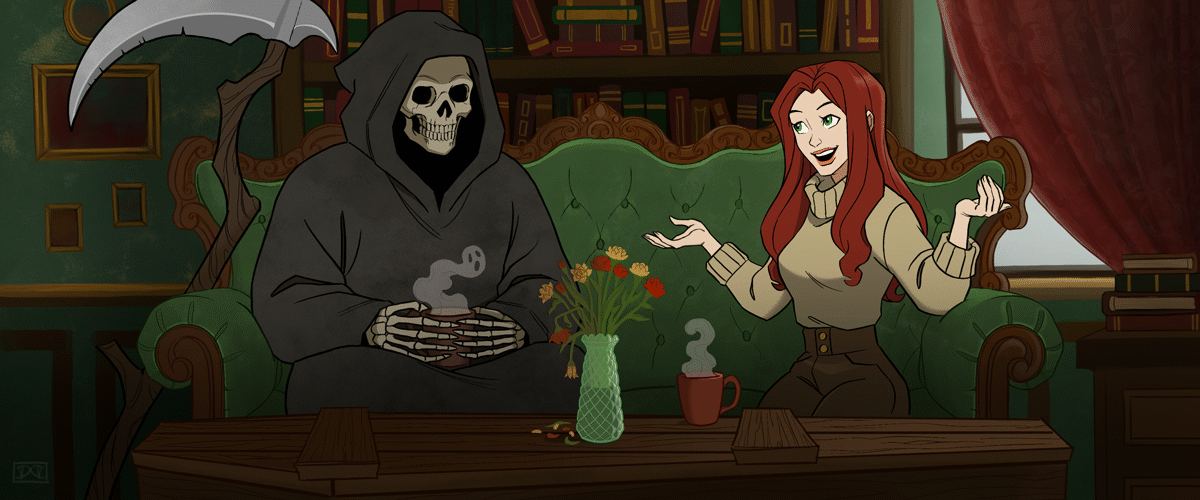
A short story with Quinley & Herrow

Who are Quinley and Herrow?
In Coffinfolk Café’s stand alone short stories, you’ll meet two most unlikely friends:
Quinley – Coffinfolk’s café host. A young woman who loves life just as much as she loves exploring the cultural heritage of death and sharing advice, information, and insights that can help people – whether they are facing their own encounter with Death or living with grief.
Herrow – Death himself. He may look frightening in his black cloak, but beneath the bones is a kind soul who enjoys a cup of coffee and sharing experiences gathered from every corner of time.
You can find a longer introduction + a short story about their first meeting HERE
“The Café’s First Guest”
Narrated by Quinley
Before the very first visitor had even crossed the threshold, he had already moved in.
Out of nowhere, there he was, sitting right in the middle of the floor – the black creature with his large amber eyes, floppy ears, and bushy tail. The café had gained its very own church grim; Grimmy.
I sat curled up in one of the café's sofas, my feet resting on the edge of the simple wooden coffin we used as a coffee table. Across from me sat the Reaper, Herrow, deeply absorbed in a book about gravestone trends throughout history.
At one of the tables by the window sat Thomas. On the table before him was a checkers board with the flat, round pieces laid out. He used to come here every week and play with his father while they drank a cup of coffee and shared a blueberry muffin. After a hiatus, he had finally returned. Alone. With a sigh, Thomas had placed a framed photo of his late father on the table. Both his coffee and his muffin stood untouched.
I felt the familiar pads of paws along the back of the sofa, a nearly soundless thud on the floor, and then they padded over to Thomas’s table.
I smiled to myself as Grimmy jumped up onto the empty chair opposite Thomas and wrapped his tail neatly around himself.
Thomas rested his chin in his hand, staring out the window. Outside, people passed by as if nothing had changed, unaware that the world had lost a beloved father.
Grimmy pawed at one of the checkers pieces. The soft scraping sound pulled the man out of his daydream. He looked down at the board in confusion, then at his father’s photo.
“Are you still cheating, even from beyond the grave, old man?!” Thomas shook his head and took a sip of coffee. Grimmy blinked slowly and let out that unique purring sound — too deep for a cat, too delicate for a dog.
I leaned toward Herrow and whispered so low only he could hear me:
“How can Grimmy be so sweet and gentle? I thought church grims were supposed to look terrifying?” The Reaper glanced up from his book.
“Have you ever seen him angry?” I bit my lip and shook my head. “Be glad for that… you don’t want to be the one who makes him bare his teeth. Trust me.” Herrow chuckled quietly and returned to his book.
We had — so far — never needed to show a guest the door. Perhaps that was Grimmy’s doing? His mere presence might be enough to keep troublemakers away.
I looked back toward Thomas. He had finally started nibbling at his muffin, the other half resting on the plate. I had to bite my cheek to keep from laughing as Grimmy slowly reached out a paw toward the tempting treat.
“Careful, or you’ll lose your dad’s half of the muffin!” I warned Thomas with a giggle. Grimmy shot me a glare. Thomas gave me a questioning look. “Your company — Grimmy, our guardian with a sweet tooth,” I explained, nodding toward the chair opposite him.
He rolled his eyes and shook his head at me, as if I were just spouting nonsense.
“A church grim here in the café?” Thomas snorted with a smile. He looked back at the board and moved his piece. “Your turn… old man…” he murmured to himself, sliding the plate with the other half of the muffin across to Grimmy, who devoured it in no time. A small smile tugged at the grieving son’s lips.
Grimmy took his duty of guarding the mood — and taste-testing our muffins — very seriously. He truly was the right grim for the job.