
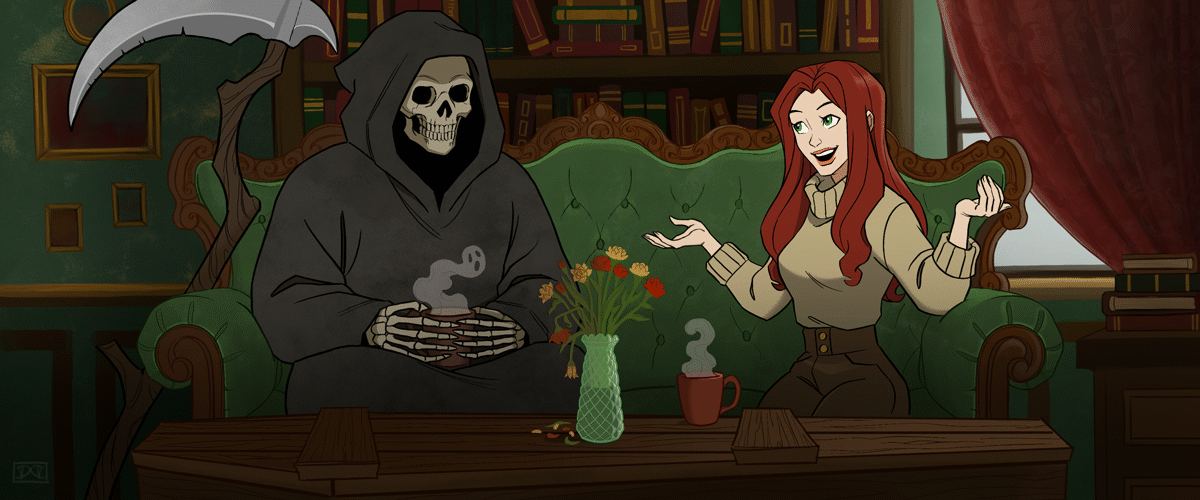

The grim reaper, the reaper, the pale rider…
Death has many names, but we all recognize the image: a skeleton in a black cloak, wielding a scythe.
How did the Reaper become the iconic image of Death? And why is he carrying a scythe?
In this post, you can read more about the history and symbolism of the Grim Reaper.
Image: 'La Mort' by Henri Bonnart (1642 - 1711)
The Black Death – the pandemic that reshaped Europe and the image of Death
Between 1347–1351, the Black Death swept through medieval Europe, killing somewhere between 30–60% of the population. Exact figures for Sweden are unknown, but estimates place the death toll between 30–40% of the population.
Before this catastrophic pandemic, Death was often depicted as a fate or punishment handed down by a god, goddess, or other figure from folklore.
In Sweden and the Nordic countries, it might have been the death goddess Hel, or the "plague hag" Pesta, who with her rake or broom came to harvest human lives.
But when Death became an ever-present reality, the image shifted into something more concrete.
Death was no longer just fate – Death was a figure of its own.
Why a skeleton?
In the Middle Ages, the skeleton was a common symbol of death. It represented the inevitable decay of the human body after death. It was a reminder of the words of the Bible: “For dust you are and to dust you shall return” or the Latin Memento Mori – “Remember that you will die.”
Why a cloak?
The black hooded cloak is believed to come from religious funeral ceremonies, where priests wore similar garments. It may also be connected to burial shrouds – the cloth in which the dead body was wrapped, sometimes instead of a coffin.
The hood, which sometimes hides the Reaper’s face, may symbolically make Death anonymous, impersonal, and, under certain circumstances, unknowable. One never knows in what form Death may arrive.
Why a scythe?
The scythe was a familiar tool in the Middle Ages – simple, powerful, and heavy with symbolism. Farmers used it to harvest grain or cut hay, and in the same way, one could imagine Death harvesting human lives. Unlike swords or spears, which were tied to battle and war, the scythe carried a sense of inevitability and everyday life. The Reaper does not kill – he gathers what life has left behind. And everyone knew that harvest time always came.
Danse Macabre – the Dance of Death
Danse Macabre is a motif in art and literature that became popular after the Black Death in the 14th century and helped spread the new image of the Reaper across Europe through church paintings, manuscripts, and literature.
It depicts Death (often as a skeleton, sometimes with a scythe, sometimes without) dancing with people of all social classes – from popes and kings to peasants and children – reminding us that death does not discriminate. Death does not judge – Death comes for all, regardless of wealth, piety, or power. This universal, inescapable nature is what stands at its core.
From fate to figure to immortal icon.
The Grim Reaper as we know him today – a skeleton in a black cloak with his faithful scythe by his side – was born out of fear, grief, and uncertainty in the aftermath of the Black Death.
From Hel and Pesta to the Grim Reaper – Death has taken many forms, but the image of the skeleton with the scythe continues to endure to this day.

Do you want to explore your own image of 'Death'? Click here!
A short story with Quinley & Herrow

Who are Quinley and Herrow?
In Coffinfolk Café’s stand alone short stories, you’ll meet two most unlikely friends:
Quinley – Coffinfolk’s café host. A young woman who loves life just as much as she loves exploring the cultural heritage of death and sharing advice, information, and insights that can help people – whether they are facing their own encounter with Death or living with grief.
Herrow – Death himself. He may look frightening in his black cloak, but beneath the bones is a kind soul who enjoys a cup of coffee and sharing experiences gathered from every corner of time.
You can find a longer introduction + a short story about their first meeting HERE
“Grim Reaper and Style Icon”
Narrated by Quinley
One of the café’s guests had donated a new painting, now hanging on the wall. The scene showed a skeleton with a scythe in hand, dancing in a square with people of different ages and social classes.
There was something beautifully macabre about it. The skeleton almost seemed to have a little smirk on its nonexistent lips, as if to say: “Don’t think you have any reason to be spared – I’m here to collect you all!” At the same time, the dancing people seemed to respond: “We will all die, so let’s live life while we still can!”
I jumped when I heard a dull thumping and soft clicking sound behind me. The familiar rhythm of Herrow’s scythe striking the floor, followed by his quiet footsteps.
“Danse Macabre.” The Reaper pointed a bony finger toward the painting. “Humanity’s way of using creativity to make the incomprehensible more understandable during the ravages of the Black Death.”
I tilted my head, my eyes flicking from the painted Reaper to the one standing beside me. I frowned.
“Why just a skeleton? Why not a character with, uh, a bit more meat on the bones, so to speak?”
Herrow took my hands in his.
“Close your eyes, and I’ll show you.” I did as I was told, and he guided one of my hands to my own face, and the other to his. With gentle pressure, he traced my fingertips along the contours of the bone beneath my eye, mirroring the movement at his own empty eye socket. He guided my hand down to where the cartilage of my nose met bone, further over the cheekbone, and down to the jawline.
“Feel that? We’re the same – with only one difference: I am what you become after some time in the grave. I’m a reminder that you are mortal.”
A shiver ran down my arms, not of discomfort, but a strong reminder that I am alive, here and now. I blinked a few times.
“And the cloak?” I swept my hand across the flowing black fabric. Herrow shrugged with a clicking sound.
“Some say it comes from priests’ garments, others that it’s a form of burial shroud.” He hugged himself in demonstration.
“It looks very comfortable, like wearing pajamas all the time,” I giggled.
“Oh yes. And black goes with everything.” chuckled Herrow, leaning on his scythe.
“Don’t you ever get tired of lugging that scythe around? It’s beautiful, but looks so unwieldy.” My eyes followed the long, curved blade that had long since lost its sharpness.
Herrow glanced at his faithful companion.
“Never underestimate a really good stick, Quinley.” He shifted the scythe from one hand to the other. “Besides, it makes an excellent back scratcher.”
I laughed and perched on the armrest of the nearest sofa. Looking back at the painting, I said:
“I get why this image of you has become so iconic. Not just because it has lived on for over 700 years, but… it really is you.”
“A classic is a classic for a reason.”
Herrow, the timeless style icon, straightened his back.
The clock on my phone read 9:45. The café didn’t open for another fifteen minutes. I turned up the volume on the radio.
“Come, Herrow. Dance with me – not because I’m going to die, but because I am alive. Here and now.”
The Reaper set down his scythe and took my hands.
“I don’t just have a sense of style – I’ve got the rhythm in my bones!”